
Many treatments in psychology grow slowly, but EMDR began with one therapist noticing something unusual during an ordinary walk. Knowing who invented EMDR therapy helps explain how that small moment grew into a widely used approach for trauma care.
The Moment of EMDR Discovery
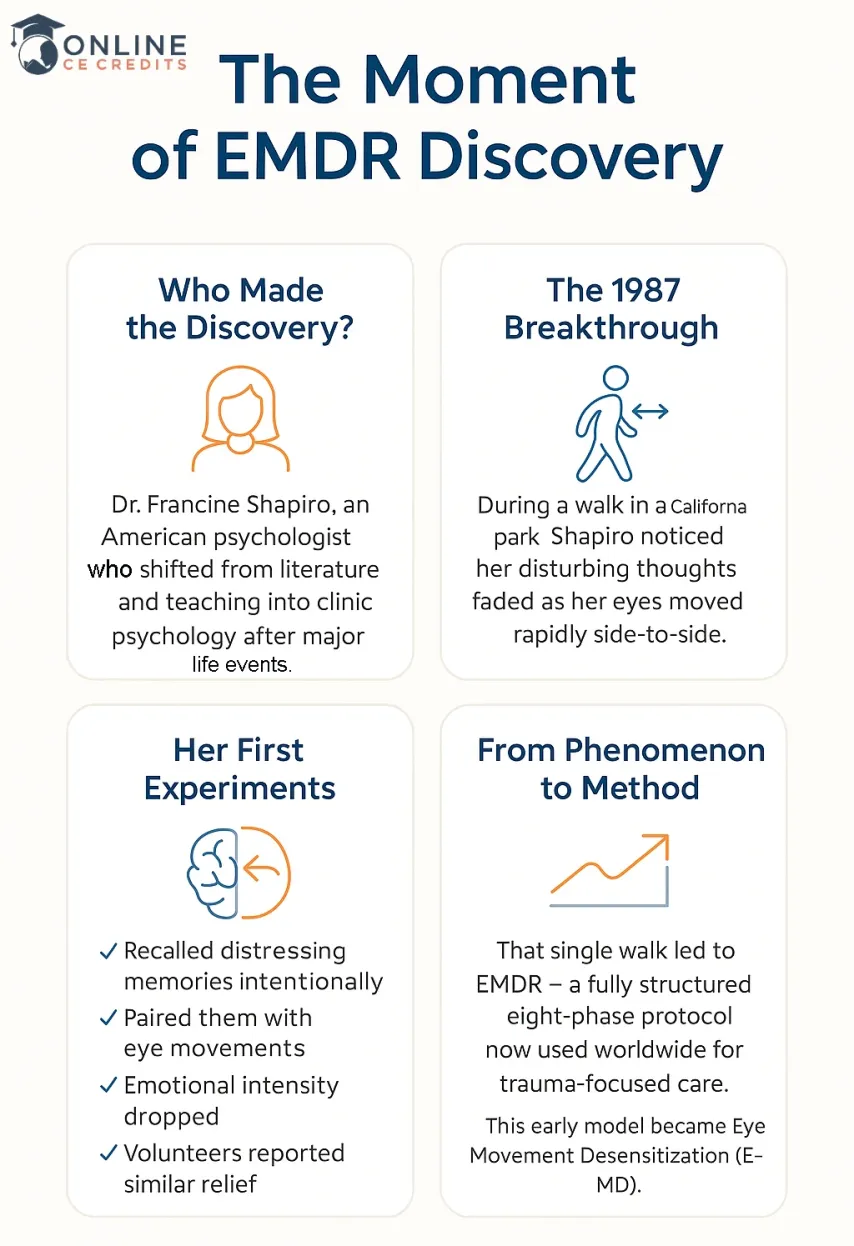
The EMDR founder was Dr. Francine Shapiro, an American psychologist who did not begin her career in experimental psychiatry. She first trained in English literature, taught high school, and then shifted toward clinical psychology after her own health and life events pushed her toward mind-body questions.
In 1987, walking through a park in California, Shapiro noticed something odd. Disturbing thoughts had been running through her mind. She became aware that her eyes were moving rapidly from side to side. As her eyes moved, the emotional charge of those thoughts seemed to drop.
Shapiro did not stop at one moment of relief. She tried to bring up a distressing memory on purpose, then deliberately moved her eyes again. The intensity dropped once more. She then asked volunteers with traumatic memories to do something similar. Many reported less distress when they paired recall with eye movements.
At this stage, she had a phenomenon, not a full treatment. The eye movements alone did not create stable change for all clients. So she began to add structure: a clear focus on a specific traumatic event, negative cognition, body sensations, and a sequence of bilateral stimulation.
She called this first structured method the Eye Movement Desensitization Procedure or EMD.
That simple walk became the seed of what clinicians now know as EMDR therapy (Eye Movement Desensitization and Reprocessing), a full eight-phase protocol used worldwide.
Development and Early Research of EMDR
After the first observations, Shapiro moved quickly into research. She completed a doctoral project at the California School of Professional Psychology that tested EMD with people who had traumatic stress linked to war, assault, and abuse.
In her 1989 paper “Efficacy of the Eye Movement Desensitization Procedure in the Treatment of Traumatic Memories”, she reported on 22 adults with trauma-related symptoms. Many had intrusive images, sleep disturbance, and high distress tied to a single event. After EMD, participants showed large drops in subjective distress scores and more positive beliefs about themselves when they thought about the target event.
The same year, she published “Eye Movement Desensitization: A New Treatment for Post Traumatic Stress Disorder”. That article described EMD as a potential new behavior therapy for post traumatic stress disorder, using bilateral eye movements while the client held a trauma image in mind.
Shapiro did not claim that one session cured all posttraumatic stress disorder symptoms. She noted that eye movement work seemed to desensitize anxiety around specific memories and shift cognitions, but that full treatment of PTSD often needed several sessions and broader support.
Early on, many researchers and clinicians were skeptical. Eye movements felt unusual. Mechanisms were unclear. Yet as more randomized controlled trials appeared through the 1990s, EMDR moved from a fringe idea to a serious trauma-focused option that could sit beside exposure and cognitive therapies.
Naming and Theory: From EMD to EMDR

By 1991, Shapiro realized that the method did more than simple desensitization. Clients did not only feel less distress. They often reported new insights and different beliefs about themselves after sessions.
She renamed the method Eye Movement Desensitization and Reprocessing, or EMDR therapy, to reflect both emotional relief and cognitive change. The added word “Reprocessing” signaled that something seemed to shift in how the brain stored and linked trauma related material.
To explain this, Shapiro proposed the Adaptive Information Processing (AIP) model. In plain language, AIP suggests that the brain normally processes difficult experiences and stores them in a flexible way.
When events are overwhelming, that process can get stuck. Sensations, images, and beliefs can stay “frozen” and trigger intense reactions years later. EMDR aims to restart this processing so that traumatic memories become integrated, less vivid, and less emotionally loaded.
Milestones and Spread of EMDR
From the late 1980s onward, the EMDR therapy development timeline is dense. A few key points:
- 1987-1989: First observations in the park, early case reports, and the main 1989 trials on EMD in traumatic stress and PTSD.
- 1990-1995: Large-scale trainings begin. The EMDR Institute forms to standardize teaching. More clinical trials compare EMDR with other trauma focused treatment approaches. Shapiro publishes the first edition of her book, Eye Movement Desensitization and Reprocessing: Basic Principles, Protocols, and Procedures.
- Mid to late 1990s: Independent groups replicate EMDR outcomes with civilians and veterans with post traumatic stress disorder. Reviews by professional bodies list EMDR among therapies with “probable efficacy” for PTSD.
- 1995 onward: The EMDR humanitarian assistance programs begin to take shape, offering training and trauma response after disasters such as the Oklahoma City bombing and later events worldwide.
Over time, EMDR gained recognition in treatment guidelines. The World Health Organization lists trauma focused CBT and EMDR as recommended psychological interventions for adults with PTSD. The VA/DoD PTSD guideline for veterans describes EMDR as a trauma focused psychotherapy with strong support.
Who Was Dr. Francine Shapiro?

Beyond the method, many clinicians want to know more about the person behind EMDR.
Francine Shapiro was born in New York City in 1948. She completed her BA and MA in English literature at Brooklyn College before turning toward psychology.
After her own cancer diagnosis and recovery, she became more focused on health, stress, and the mind-body link. This path eventually led to her doctorate in psychology and her work at the Mental Research Institute in Palo Alto, a center known for behavior therapy and family oriented models.
Her EMDR work brought many awards, including the International Sigmund Freud Award for Psychotherapy in 2002, given in Vienna in partnership with the World Council for Psychotherapy.
Shapiro wrote both technical texts and public facing books on EMDR, including later editions of her main textbook that refined the AIP model and updated protocols.
Why It Matters for Trauma Focused Practice
Knowing who invented EMDR therapy does more than satisfy curiosity. It roots clinical work in a clear EMDR history that blends observation, research, and ongoing refinement.
For trauma focused clinicians, EMDR sits alongside cognitive and exposure based treatments for post traumatic stress disorder. The American Psychological Association PTSD guideline lists EMDR as an intervention with strong evidence when used in a structured way.
EMDR is used not only for single incident trauma. Many clinicians also apply it with complex trauma, moral injury, and some forms of anxiety, while staying within research and ethical limits.
Understanding how EMDR began helps many therapists feel more confident about using it in the therapy room. It also shows why solid training really matters. That is why Online CE Credits offers EMDR courses, the EMDR Therapy Skills Certificate, and the Advanced EMDR Skills Certificate. Each one is built to support clinicians who want reliable guidance, practical tools, and CE hours they can trust, without adding extra weight to an already demanding schedule.
Points of Debate and Considerations

From the start, EMDR raised questions. Some researchers asked if the eye movements really added anything beyond imaginal exposure. Others debated how to classify EMDR inside therapy processes and behavior therapy traditions.
Studies that removed eye movements and used only recall and fixation sometimes found weaker effects, while other trials suggested that dual task demands may tax working memory and reduce the vividness of traumatic memories. The exact mechanism is still under study.
How This Origin Story Links to CE Credit Needs
For busy clinicians, it can be easy to view EMDR as just another protocol. Yet the origins of EMDR remind the field that this method emerged from careful observation, experimental psychiatry research, and decades of refinement.
Knowing that history supports ethical practice in several ways:
- It keeps claims modest and in line with data.
- It highlights the importance of proper training, consultation, and adherence to protocol.
- It frames EMDR as one part of a broader trauma toolkit, not a standalone cure.
Continuing education in EMDR should do more than teach steps. It should connect the EMDR therapy development timeline with present day clinical choices, including case selection, risk management, and work with family and community systems.
Clinicians who want structured learning can explore a range of EMDR courses that link Shapiro’s original work to current practice standards, while earning CE credit in a flexible format that fits real schedules.
Read more: Is EMDR Training Worth It?
References
[1] Shapiro, F. (1989). Efficacy of the eye movement desensitization procedure in the treatment of traumatic memories. Journal of Traumatic Stress, 2, 199-223. https://psycnet.apa.org/record/1989-40656-001
[2] Shapiro, F. (1989). Eye movement desensitization: A new treatment for post-traumatic stress disorder. Journal of Behavior Therapy and Experimental Psychiatry, 20, 211-217. https://pubmed.ncbi.nlm.nih.gov/2576656/
[3] Shapiro, F. (1995). Eye Movement Desensitization and Reprocessing: Basic Principles, Protocols and Procedures. Guilford Press. https://archive.org/details/eyemovementdesen0000shap_c1
[4] Shapiro, F. (1999). Eye Movement Desensitization and Reprocessing (EMDR) and the anxiety disorders: Clinical and research implications of an integrated psychotherapy treatment. Journal of Anxiety Disorders, 13(1-2), 35-67. https://pubmed.ncbi.nlm.nih.gov/10225500/
[5] American Psychological Association. (n.d.). Eye Movement Desensitization and Reprocessing (EMDR) Therapy. APA PTSD Treatment Guidelines. https://www.apa.org/ptsd-guideline/treatments/eye-movement-reprocessing
[6] Hill, M. D. (2020). Adaptive Information Processing Theory: Origins, Principles, Applications, and Evidence. Journal of EMDR Practice and Research, 17(3), 317-331. https://pubmed.ncbi.nlm.nih.gov/32420834/
[7] Francine Shapiro Library. (2024). In Celebration of EMDR. https://francineshapirolibrary.omeka.net
