
Some clients walk in asking, “Is EMDR right for me?” or “Have you heard of Brainspotting?” Others just know that traditional talk therapy has not helped them fully heal.
Both EMDR and Brainspotting move beyond words, tapping into the body and nervous system to process trauma, but they work in different ways.
Here, we will compare Brainspotting vs. EMDR: how they differ, what the research says, and how clinicians can decide which approach best fits each client’s needs.
Quick Answer – What’s the Difference Between EMDR and Brainspotting?
EMDR uses bilateral stimulation and a structured eight‑phase protocol to reprocess traumatic memories.
Brainspotting suggests that holding gaze at a “brainspot” taps into somatic and subcortical processing.
One is highly protocolized; the other is more flexible and emergent.
Here is a better representation:
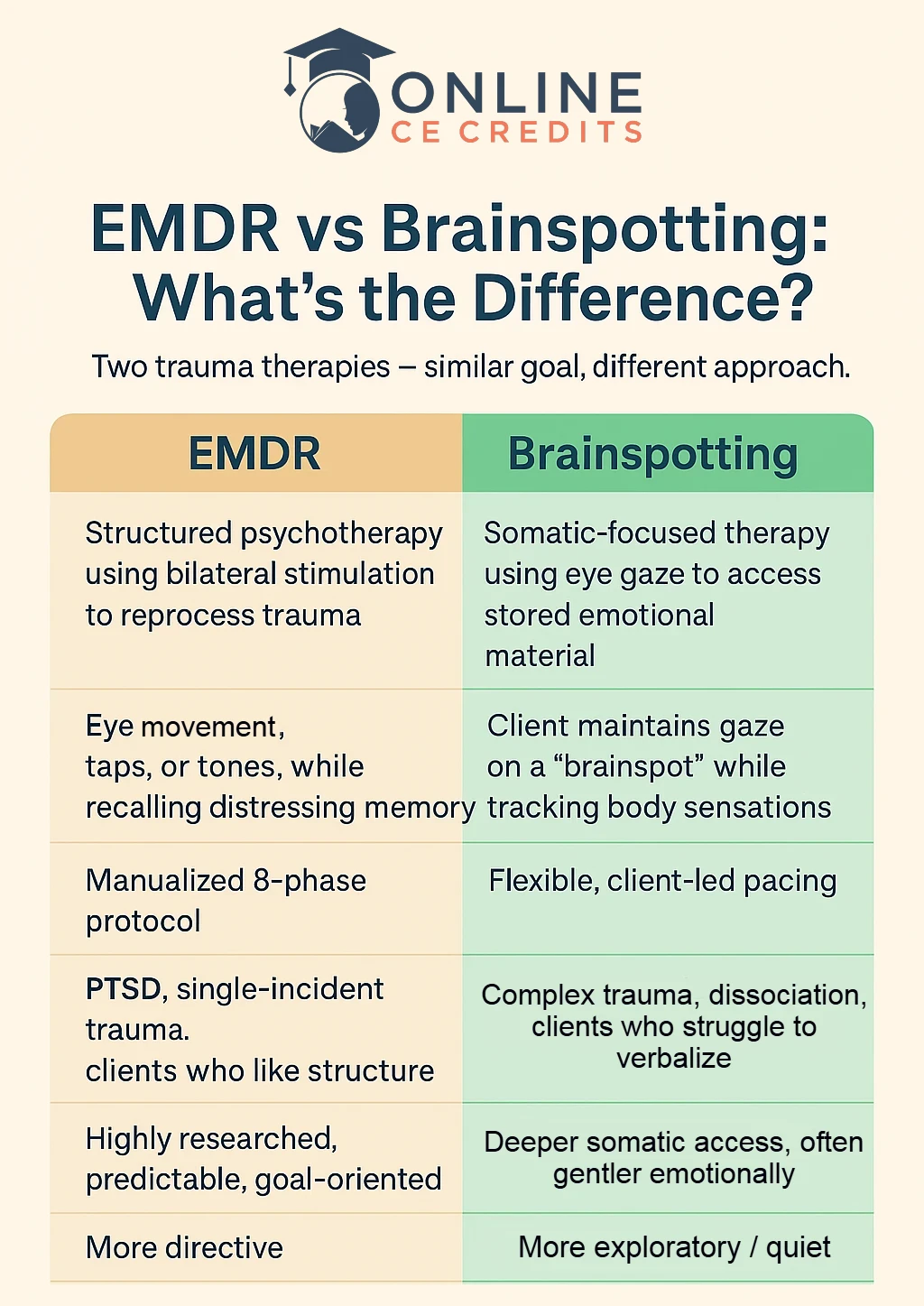
| Factor | EMDR Therapy | Brainspotting |
| Method | Bilateral stimulation + memory reprocessing | Gaze fixation on a “spot” + somatic attunement |
| Structure | Standard 8‑phase protocol | Flexible, client-driven pacing |
| Research Base | Strong, many RCTs, WHO & VA endorsement (PTSD) | Emerging, small comparative trials and white papers |
| Best For | Clients who prefer structured protocols and cognitive access | Clients who respond more somatically or dislike heavy narrative |
| Session Experience | More talk, directive prompts, structured sets | Less talk, more internal exploration |
What Is EMDR Therapy?
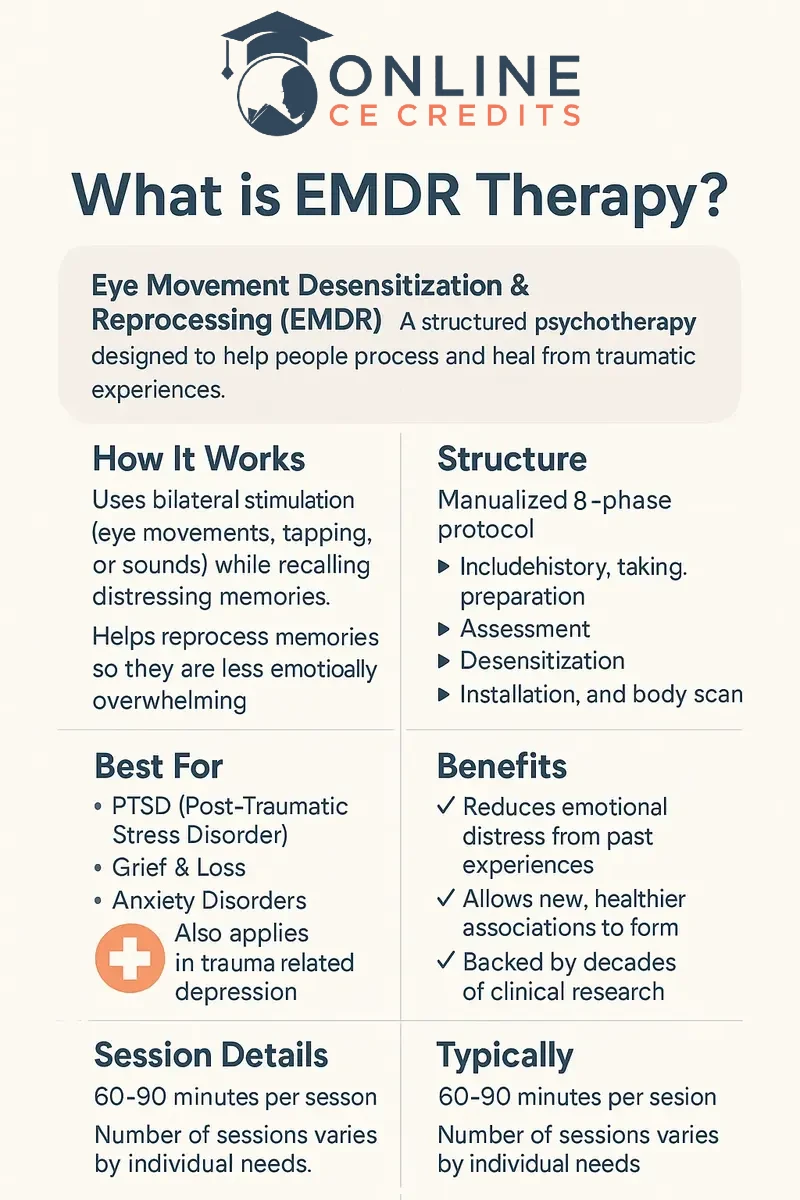
EMDR therapy (Eye Movement Desensitization and Reprocessing) was developed in the late 1980s by Dr. Francine Shapiro.
It operates on the Adaptive Information Processing (AIP) model, which posits that traumatic memories persist because they are not adequately processed and are stored in maladaptively linked networks.
Through alternating bilateral stimulation (eyes, taps, tones) while accessing a memory, the brain is assisted to reprocess that traumatic content adaptively.
EMDR sessions follow a structured eight‑phase protocol: history, preparation, assessment, desensitization, installation, body scan, closure, and reevaluation.
Therapists require training and supervision to maintain fidelity to the model. Many trauma guidelines (e.g., WHO, VA) list EMDR as a first‑line option, especially for PTSD.
For those interested in developing their skills, Online CE Credits offers both foundational and advanced options, including:
- Certificate in EMDR Therapy Skills
- Advanced EMDR Certification
- And an entire catalogue of EMDR-focused CE courses.
What Is Brainspotting Therapy?

Brainspotting (BSP) was introduced by Dr. David Grand around 2003.
The name comes from the hypothesis that “where you look affects how you feel.” In practice, a therapist helps a client find a visual spot (brainspot) that corresponds to a bodily or emotional activation tied to trauma.
The client maintains their gaze there, noticing sensations, images, or internal shifts, with minimal narrative instruction.
The idea is that gaze links to subcortical and somatic circuits, allowing for deeper implicit processing. BSP is sometimes described as “bottom‑up first” and is considered a more somatic, emergent form of therapy.
According to Brainspotting’s own site, the Hildebrand / Grand / Stemmler comparative study found both EMDR and BSP led to symptom reduction over several sessions. Still, the evidence is nascent.
EMDR vs Brainspotting – Key Differences Explained
Continue Your Learning
Recommended Courses
Although both therapies aim at trauma resolution, their paths diverge in important ways.
Structure vs Flexibility
EMDR relies on a fixed protocol. The phases guide the clinician and client step by step. The structure offers predictability, which many clients appreciate.
Brainspotting, by contrast, is looser. There is no fixed set of eye movements or strict phases. The therapist responds to what emerges in the client moment by moment.
Cognitive Processing vs Somatic Access
EMDR tends to incorporate cognitive elements, including identifying negative and positive beliefs, rating distress, and encouraging insight.
Brainspotting favors somatic access: the focus often is on what the body is saying. Rather than trying to reframe or challenge beliefs, BSP suggests working through bodily activation, allowing implicit emotional processing to unfold.
Client Comfort & Emotional Intensity
Brainspotting’s gentler style can feel safer emotionally, especially for clients with high sensitivity or those prone to dissociation.
A 2022 study in the International Journal of Environmental Research and Public Health compared Brainspotting to EMDR and found both to be effective in reducing distress linked to traumatic memories, offering promising evidence for BSP’s clinical value.
However, because BSP gives less structure, some clients may feel adrift or overwhelmed by internal signals that emerge.
Which Is More Effective? What Research Says

Both practices have clinical promise. However, the evidence base is much stronger for EMDR at present.
Evidence for EMDR
EMDR is supported by dozens of randomized controlled trials, meta-analyses, and practice guidelines (WHO, VA, APA, in some cases). Its efficacy for post traumatic stress disorder is well documented.
It has consistent evidence for reducing intrusive memories, negative beliefs, and avoidance symptoms in trauma populations.
Emerging Studies on Brainspotting
Brainspotting’s evidence is preliminary. The Hildebrand et al. comparative study (76 clients) found that three 60‑minute sessions of EMDR or BSP both produced significant PTSD symptom reduction at posttreatment and six‑month follow-up.
A preliminary white paper in residential trauma populations showed symptom improvements with BSP in co‑occurring trauma and substance use settings. Others caution that many BSP studies are authored by its creators and that independent replication is limited.
No Clear “Winner” – Matching Therapy to Client Needs
Given current evidence, it’s premature to claim that Brainspotting is superior or equivalent to EMDR in all cases. Instead, the clinician’s task is to match therapy to the client’s nervous system, trauma history, and preferences. Some clients may respond faster with EMDR’s structure; others may benefit from BSP’s somatic slant.
Cost & Accessibility – EMDR vs Brainspotting
| Factor | EMDR | Brainspotting |
|---|---|---|
| Availability of Therapists | Widely available — many clinicians already trained | Less common — fewer certified providers |
| Insurance Coverage | More likely to be reimbursed | Often private-pay only |
| Training Cost for Therapists | Structured certification programs, higher initial cost | Trainings are shorter and often cheaper |
| Client Cost Per Session | Typically covered or partially reimbursed | Often out-of-pocket, varies by practitioner |
| Online / Remote Options | Well-supported with virtual EMDR platforms | Possible but less formally studied |
EMDR is widely taught, and many clinicians are already trained in it. Insurance reimbursement is more established in many regions. Remote EMDR and intensives are increasingly common.
Brainspotting, by contrast, has fewer certified providers and less widespread insurance acceptance. Remote BSP is possible, but not as well researched.
Clients may have to travel farther or pay out of pocket. For many therapists, BSP is added as a complement once EMDR or foundational trauma work is already in place.
Bottom line: EMDR is easier to access, more likely to be covered by insurance, and already integrated into many clinical settings.
Brainspotting is growing but still niche — often used as a private-pay specialty or add-on modality.
Clients’ Experience from Forums

Below are anonymized client reflections to highlight the lived realities of brainspotting vs EMDR:
“I’m trained in both! EMDR is unapologetically a protocol. Brainspotting is a more open and creative model. They’re both great, but very different in feel.”
“The whole idea behind Brainspotting makes no logical sense to me, it feels mystical. EMDR at least gives me steps I can follow. But sometimes, BSP hits places that EMDR never could.”
These voices reflect how clients perceive protocol, inner access, and emotional safety in real practice.
Is EMDR or Brainspotting Therapy Right for You?
Choosing between EMDR and Brainspotting is not about which therapy is better, but what fits. Each person brings a different nervous system, trauma history, and tolerance for emotion into the room.
EMDR might be more appropriate for clients with well-defined traumatic memories, such as accidents, combat, or specific incidents of abuse. It also tends to suit those who feel comfortable with structured steps and cognitive insight.
Brainspotting may be ideal for clients who struggle to explain their experiences verbally. It is often used with complex trauma, attachment wounds, and chronic pain where the body seems to “remember” more than the mind can say.
Of course, both models can support healing from trauma, emotional distress, and unresolved trauma, they simply take different roads to get there.
For Therapists – Should You Train in EMDR or Brainspotting First?

For most clinicians, EMDR training is the more logical first step. It is globally recognised, widely reimbursed by insurance, and often requested by clients or referring providers. EMDR certification also supports billing, supervision, and inclusion in trauma networks.
At Online CE Credits, clinicians can pursue both foundational and advanced skill development with our Certificate in EMDR Therapy Skills and Certificate in Advanced EMDR Therapy Skills programs. These offerings meet licensure requirements and equip therapists to deliver ethical, evidence-based EMDR.
Brainspotting, while powerful, is often an excellent add-on modality. It is less insurance-recognised but deeply valued in integrative and private-pay settings. Many EMDR-trained therapists later add Brainspotting to deepen body-based trauma resolution or to support clients who do not respond well to cognitive processing alone.
For Therapists – Can You Combine EMDR and Brainspotting?
Yes, and many clinicians do. A common integrated approach starts with Brainspotting to help stabilize the client’s nervous system and increase somatic awareness. Once the client is more regulated, EMDR may be introduced to reprocess traumatic memories with greater safety and structure.
An increasing number of trauma-informed therapists are now dual-trained. They switch between models flexibly, or even weave BSP principles into EMDR phases.
Final Recommendation
Choosing between EMDR and Brainspotting is less about picking a winner and more about understanding what each client truly needs.
Some may benefit from EMDR’s structure and pacing. Others may feel safer starting with Brainspotting’s slower, body-led exploration.
And for many, the best work happens when both tools are used in thoughtful sequence. What matters most is offering clients a safe and supportive environment, and trusting their system to lead the way.
FAQ
Is Brainspotting more effective than EMDR?
There is no evidence showing Brainspotting is more effective overall. EMDR has stronger research, but outcomes vary by client and therapist fit.
What is the controversy with EMDR therapy?
Some critics question EMDR’s bilateral stimulation mechanism, but clinical outcomes are widely supported in treating trauma and PTSD.
What are the downsides/risks of Brainspotting?
Limited research and lack of structure may overwhelm some clients. Therapist skill and attunement are critical to maintaining safety.
Can you close your eyes during Brainspotting?
Yes, some clients process more easily with closed eyes. Others find fixed gaze helpful. Therapists adapt to individual comfort levels.
Can I do EMDR and Brainspotting online?
Yes. Both therapies can be delivered remotely, though not all clients respond equally to virtual formats.
Is Brainspotting the same as EMDR?
No. EMDR uses bilateral stimulation and structured reprocessing. Brainspotting uses eye gaze and somatic tracking without a fixed protocol.
Is Brainspotting legitimate?
Yes, Brainspotting is a valid therapeutic model. While research is still growing, many clinicians report positive results in practice.
