
A client can explain the trauma, they can name all the triggers, but their body still reacts like it is happening again. This is where EMDR can usually help, because it targets the memory network, not only the story.
Below, we compare EMDR vs traditional talk therapy, and show which approach works better in different situations.
Quick Answer: EMDR vs. Traditional Talk Therapy
Traditional talk therapy builds understanding and coping skills, while EMDR targets distressing memories so the brain can reprocess traumatic memories.

Talk therapy often changes meaning, behavior, and daily choices over time. EMDR therapy adds bilateral stimulation to help the nervous system process stuck memory networks.
That is why some clients feel a shift even when they “already know” what happened.
| Traditional Talk Therapy | EMDR Therapy | |
| Main focus | Insight, meaning, patterns, coping skills | Processing distressing memories and triggers |
| Common formats | psychodynamic therapy, humanistic therapy, CBT | 8-phase protocol with targeted reprocessing |
| Session feel | More verbal, reflective | Often less talking during processing |
| Emotional intensity | Can rise gradually through discussion | Can rise quickly during reprocessing, then settle |
| “Stuck” trauma symptoms | Can improve, but some triggers stay reactive | Often targets trigger reactivity directly |
| Homework | Journals, exposure steps, skill practice | Resourcing, grounding, between-session pacing |
| Structure | Can be open-ended | More manualized, phase-based |
| Best fit | Growth, relationships, identity, mild to moderate concerns | Treating trauma, PTSD symptoms, complex trauma themes |
What Is Traditional Talk Therapy?
Traditional talk therapy is therapy where conversation is the main tool for change. A therapist helps the client tell their story, name feelings, and spot patterns that keep the problem going.
The client shares what happened. The therapist listens for themes, beliefs, and triggers. Together, they test new ways to think, feel, and act. Over time, the client builds insight and stronger coping skills.
Different styles use that loop in different ways.
- CBT focuses on thoughts, behaviors, and small practice steps between sessions.
- Psychodynamic therapy looks at early relationships, stuck roles, and old defenses that still run the present.
- Humanistic therapy leans on empathy, safety, and a real relationship with the therapist.
What Is EMDR Therapy?
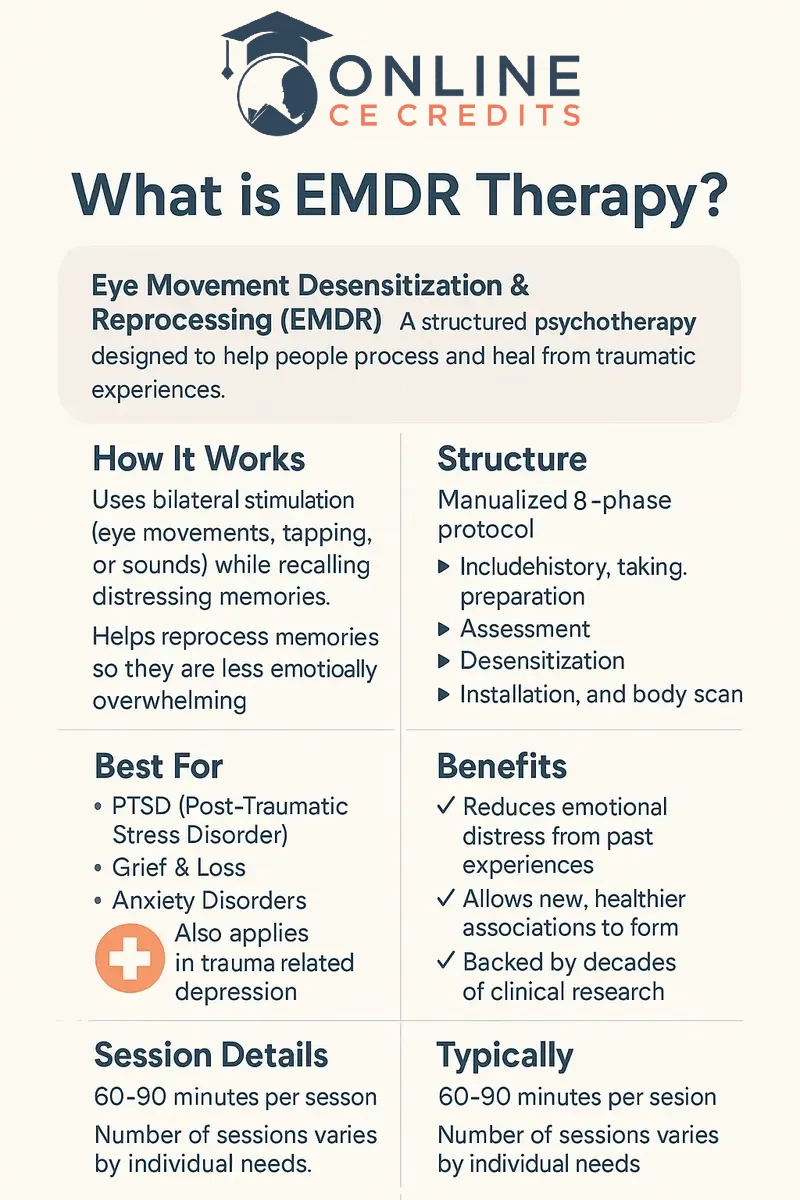
EMDR therapy (Eye Movement Desensitization and Reprocessing) is a structured trauma treatment that helps the brain reprocess distressing memories, so they stop feeling like a present threat.
Instead of only talking through the story, the client briefly holds the memory while using bilateral stimulation, like guided eye movements or tapping.
An EMDR therapist follows an 8-phase model. It starts with safety, coping skills, and a clear treatment plan. Only then does reprocessing begin.
Why EMDR Often Works When Talk Therapy Does Not
Some clients can talk about childhood trauma for years, yet still panic in the same situations. A key idea in EMDR is that the memory is not fully “filed away.” It stays linked to present triggers, body sensations, and threat responses.
One explanation, supported by research on working memory, is that dual attention tasks can reduce the vividness and emotional punch of an image. Eye movements compete for working memory resources while the memory is held in mind.
Over repeated sets, the memory often feels less sharp and less urgent. This does not mean the event disappears. It often means the client can remember it without reliving it.
EMDR also tends to be more procedural than insight-based. That structure can help when a client struggles to describe the trauma, or when shame makes talking hard.
When Talk Therapy May Be the Better Choice

Talk therapy can be a better starting point when the client needs to build trust, steady the nervous system, and strengthen coping skills.
Talk therapy may be a better fit when:
- The main goal is relationships, identity, or day-to-day functioning.
- The client is in an active crisis and needs stabilization first
- The client has high dissociation risk and needs longer preparation
- The client wants a slower, story-based pace, not protocol work
Can EMDR and Talk Therapy Be Used Together?
Yes, and many clinicians use talk therapy to build the container, then use EMDR to process specific targets.
A very common pattern most therapists use is:
- Stabilization and coping skills first
- Targeted EMDR sessions
- Integration
What Therapists Should Know When Choosing EMDR vs Talk Therapy
EMDR vs traditional talk therapy is not a contest. The real question is what the client needs next in the treatment plan.
- If the work is mostly skill building, attachment, or meaning making, talk therapy may be the best tool.
- If the client is stable, but still haunted by triggers and distressing memories, EMDR may be the missing step.
But EMDR is not something to “wing” from a video. Clinicians need a clear model, supervised practice, and consultation.
For clinicians ready to build real competence, our full set of EMDR courses lays out the options. A common path is to start with the EMDR skills certificate, use it with straightforward cases, then add the advanced skills certificate when complex trauma shows up more often.
FAQs
Is EMDR faster than talk therapy?
It can feel faster for PTSD symptoms tied to one or two target memories. Many clients report fewer triggers sooner. Also, it depends if it’s a single event or complex trauma. Talk therapy can still be faster for skills, relationships, and life stress.
Does EMDR replace psychotherapy?
No. EMDR is a type of psychotherapy, but it does not replace the full work of therapy. Many clients still need coping skills, insight, and relationship repair alongside reprocessing.
Can EMDR help if talk therapy did not work?
Often, yes, when the client has insight but still has body-level reactions. EMDR targets trigger reactivity linked to distressing memories. It still requires screening, preparation, and pacing.
Is EMDR only for PTSD?
No. EMDR is best known for PTSD, but it is also used for complex trauma themes, childhood trauma, and some anxiety presentations.
Do therapists need special training for EMDR?
Yes. EMDR therapy is structured and protocol-driven. Competent use requires training, practice sessions, and consultation.
Why do some therapists not like EMDR?
In most debates, the issue is fit, pacing, and competence. Some dislike manualized protocols or prefer open-ended talk therapy. Others worry about poor training and rushed processing.
Which clients should not do EMDR?
Clients in acute crisis, active substance instability, or severe dissociation risk may need stabilization first. EMDR can be adapted, but only with strong screening and preparation.
How is EMDR different from normal therapy?
Traditional talk therapy uses conversation to change meaning and behavior. EMDR adds bilateral stimulation and structured phases to help the brain reprocess traumatic memories and reduce trigger reactivity.
