
Two clients can carry trauma very differently. One keeps reliving a specific memory, while another feels divided between fear, shame, control, and avoidance.
That difference matters when comparing IFS vs EMDR therapy. Both approaches may support healing trauma, but they enter the work through different clinical doors.
IFS vs EMDR Therapy
IFS therapy works with the client’s internal system of protective and wounded parts. While EMDR therapy uses a structured process to help clients reprocess traumatic memories and reduce their emotional charge.
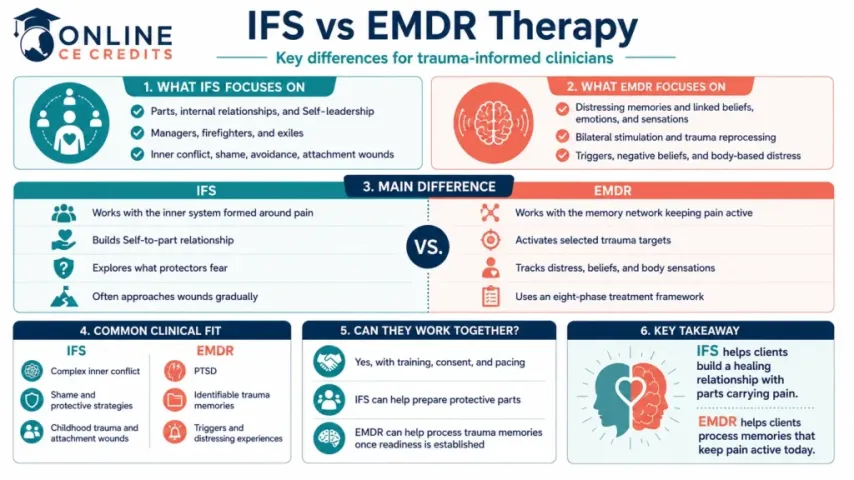
Internal Family Systems vs EMDR is therefore less about choosing a winner and more about identifying the treatment target.
| Category | IFS Therapy | EMDR Therapy |
| Full name | Internal Family Systems therapy | Eye Movement Desensitization and Reprocessing |
| Main focus | Parts, internal relationships, and Self-leadership | Distressing memories and linked beliefs, emotions, and sensations |
| Core idea | Parts carry protective roles, wounds, fears, and learned strategies | Traumatic memories may remain easily activated and poorly integrated |
| Main clinical target | Internal conflict, shame, avoidance, attachment wounds, and protective patterns | Trauma memories, triggers, negative beliefs, and body-based distress |
| Common language | Parts, Self, exiles, managers, firefighters, blending, and unburdening | Targets, bilateral stimulation, desensitization, cognitions, and body scan |
| Session style | Relational, exploratory, and experiential | Structured, phase-based, and focused on memory processing |
| Trauma discussion | Vulnerable material may be approached gradually through protectors | Clients focus on targets, although detailed verbal retelling is usually unnecessary |
| Evidence base | Growing, with newer trials and major research gaps remaining | Well-established and guideline-supported for PTSD |
| Common clinical fit | Complex inner conflict, shame, childhood trauma, and protective strategies | PTSD, identifiable trauma memories, triggers, and distressing experiences |
| Integration | May prepare protective parts for deeper trauma work | May process memories once readiness and stability are established |
Clinicians who want to explore either model further can browse our IFS courses and EMDR courses for practical, trauma-informed training.
What Is IFS Therapy?
Internal Family Systems is a therapy approach developed by Richard Schwartz that views the mind as naturally containing different parts. These parts are not treated as broken personalities. Each part developed feelings, beliefs, or behaviors that once served a purpose.

For example:
- Managers try to prevent pain through control, perfectionism, planning, or emotional distance…
- Firefighters react quickly when pain breaks through, sometimes using anger, numbing, avoidance, or impulsive behavior…
- Exiles carry older fear, shame, grief, and trauma wounds.
The IFS model helps clients approach these parts with curiosity and compassion. The wider goal is Self-leadership, where calm, clarity, connection, and choice guide the internal system.
Read more: IFS training cost
What Is EMDR Therapy?
EMDR stands for Eye Movement Desensitization and Reprocessing. It is a structured trauma therapy designed to process traumatic memories and their connected beliefs, emotions, images, and physical sensations.

During EMDR sessions, a client recalls part of a distressing experience while attending to alternating bilateral stimulation. This may involve guided eye movements, taps, or tones.
EMDR follows eight phases covering history, preparation, assessment, desensitization, installation, body scan, closure, and reevaluation.
The Main Difference Between IFS and EMDR
The clearest difference is what each approach organizes the session around. IFS focuses on the inner system that formed around pain. EMDR focuses on the memory network keeping that pain active.
IFS asks, “Which part carries this fear, shame, anger, or need for protection?” EMDR asks, “Which memory, belief, emotion, and body sensation need reprocessing?”
| IFS | EMDR |
| Builds a Self-to-part relationship | Activates a selected trauma target |
| Explores what protectors fear might happen | Tracks distress, beliefs, and physical sensations |
| May map managers, firefighters, exiles, and polarized parts | Sequences past memories, current triggers, and future situations |
| Often earns protector trust before approaching wounds | Begins trauma reprocessing after preparation and readiness |
| Uses compassion, unblending, witnessing, and unburdening | Uses dual attention and bilateral stimulation |
| Follows the client’s internal system | Follows an eight-phase treatment framework |
IFS helps clients build a healing relationship with parts carrying pain. EMDR helps clients process memories that keep pain active today.
IFS vs EMDR for PTSD
EMDR has the stronger established evidence base for PTSD. VA/DoD places EMDR alongside Prolonged Exposure and Cognitive Processing Therapy among the most effective trauma-focused treatments.

IFS research is newer, although it has moved beyond case reports. A 2025 scoping review mapped 27 peer-reviewed studies and described IFS as promising for PTSD, depression, chronic pain, and self-compassion. However, only two included studies were randomized trials, leaving important evidence gaps.
Also, a 2026 randomized trial found greater PTSD symptom improvement from an online, group-based IFS program than its comparison condition. This adds meaningful evidence, but does not yet place IFS beside guideline-supported PTSD treatments.
Clinically, EMDR may fit identifiable trauma targets. IFS may help when protective parts, shame, avoidance, or internal conflict interfere with direct trauma work.
IFS vs EMDR for Complex Trauma
Both approaches may support complex trauma treatment, but readiness often matters more than modality preference.
Complex trauma may involve childhood trauma, attachment wounds, dissociation, emotional dysregulation, shame, conflicting trauma responses, and strong protector strategies.
- IFS can help the therapist understand which parts fear deeper trauma processing and what they need before proceeding.
- EMDR can reprocess traumatic memories within a wider treatment plan, but preparation, resourcing, and careful target selection remain essential.
A 2025 clinical perspective proposed combining IFS-informed preparation with EMDR for severe dissociation. However, the paper presented a theoretical framework rather than a clinical trial.
For complex trauma, the central question is often what the client’s nervous system and inner system need before deeper processing begins.
IFS vs EMDR for Anxiety and Depression
IFS therapy vs EMDR therapy depends on what appears to drive the anxiety or depression.
IFS may help when anxiety involves controlling managers, alarmed protectors, avoidant parts, or firefighters trying to stop emotional overwhelm. With depression, IFS may explore hopeless parts, harsh inner critics, shame-carrying exiles, or protectors that withdraw from relationships.
EMDR may fit when symptoms connect clearly to distressing memories, grief, humiliation, attachment injuries, or negative beliefs. An EMDR therapist might target the experience linked to “I am unsafe” or “I am worthless,” then track how its emotional charge changes.
IFS vs EMDR Techniques
IFS mainly works through internal relationships, while EMDR organizes trauma work around memory networks.
| Clinical Focus | IFS Technique or Concept | EMDR Technique or Concept |
| Trauma memory | Witnessing exile experiences and unburdening | Processing a selected target memory |
| Emotional overwhelm | Unblending and building Self-energy | Preparation, resourcing, pacing, and closure |
| Self-criticism | Understanding the critic’s protective role | Reprocessing memories linked to negative cognition |
| Avoidance | Exploring what protectors fear | Targeting memories and triggers tied to avoidance |
| Shame | Compassionate Self-to-part relationship | Reprocessing shame-linked memories and beliefs |
| Dissociation | Protector permission and internal cooperation | Stabilization and readiness before processing |
| Triggers | Mapping which parts become activated | Processing earlier events linked to current triggers |
| Body sensations | Exploring sensations carried by parts | Tracking sensations and completing the body scan |
| Internal conflict | Working with polarized parts | Sequencing multiple linked targets |
What Happens in an IFS Session?
An IFS session usually starts with the strongest inner reaction showing up in the moment. The therapist helps the client slow it down, identify which part is active, and understand what that part fears or protects.

- The client notices an active part. This might appear as tension, criticism, fear, numbness, anger, or an urge to leave.
- The therapist invites curiosity. The client observes where the part appears and how they currently feel toward it.
- Other reactions are separated. If one part hates or fears another, the therapist may help it step back temporarily.
- The part explains its role. The client explores what it does, what it fears, and whom it believes it protects.
- Protectors build trust. Managers or firefighters may need reassurance before allowing contact with vulnerable material.
- Wounded parts may become accessible. Exiles can share emotions, memories, beliefs, and unmet needs without being rushed.
- The work moves toward unburdening. Using IFS, clients may release old shame, fear, or beliefs carried by wounded parts.
Is IFS or EMDR Better Overall?
Neither approach is automatically better overall. The stronger fit depends on symptoms, readiness, goals, stability, and case conceptualization.
| Clinical Situation | Possible Fit |
| Clear and distressing trauma memories | EMDR may offer a more direct trauma reprocessing path |
| Strong inner conflict or protective behavior | IFS may provide a useful map for parts work |
| Complex trauma and attachment wounds | Both may serve different stages of treatment |
| High dissociation or instability | Stabilization should come before modality preference |
| Multiple connected trauma targets | EMDR target sequencing may help organize treatment |
| Parts resisting trauma processing | IFS may clarify fear and build internal permission |
Can IFS and EMDR Be Used Together?
Yes, clinicians can integrate IFS and EMDR, but the combination needs clear reasoning, training, consent, and pacing.
IFS can identify protectors that fear trauma treatment or expect the client to become overwhelmed. The therapist may work with those parts before beginning EMDR desensitization. EMDR can later help reprocess traumatic memories carried by vulnerable parts.
This integration should never become a loose collection of techniques. Clinicians need competence in both models and should explain why each intervention belongs in the treatment plan.
What Therapists Should Know About IFS vs EMDR
IFS should not be reduced to simply “talking to parts,” and EMDR involves far more than following eye movements.
EMDR focuses on structured assessment, preparation, target selection, processing, closure, and reevaluation. IFS focuses on internal relationships, protection, unblending, Self-leadership, and the healing process between Self and parts.
The evidence also differs.
EMDR has broad guideline support for PTSD, while IFS research remains smaller despite encouraging recent trials. A 2025 study of 697 adults examined links between childhood trauma, IFS concepts, PTSD symptoms, and disturbances in self-organization. Such findings support continued research, but they do not establish treatment effectiveness.
Good trauma-informed care still depends on ethics, consultation, case conceptualization, and client-centered pacing.
Learn Trauma Therapy Skills With Online CE Credits
Trauma clients rarely arrive with one clean symptom or one simple memory. Clinicians, therefore, need education that supports the difficult decisions between preparation, parts work, stabilization, and trauma reprocessing.
At Online CE Credits, we offer flexible IFS courses covering protectors, exiles, polarized parts, shame, anxiety, attachment, and trauma-informed therapy. We also have EMDR courses with training on all eight phases, complex trauma, dissociation, anxiety, depression, telehealth, children, and protocol modifications.
Clinicians seeking a structured path can explore our 23-CE foundational EMDR certificate or 32-CE advanced program. Both support flexible online learning, practical skills, and consultation opportunities for counselors, social workers, therapists, psychologists, and MFTs.
FAQ
Is IFS the same as EMDR?
No. IFS works with parts, Self-leadership, and internal relationships. EMDR uses bilateral stimulation within a structured process for distressing memories.
Is IFS or EMDR better for trauma?
It depends on the treatment target. EMDR has stronger PTSD evidence, while IFS may help with protectors, shame, avoidance, and inner conflict.
Can IFS and EMDR be combined?
Yes. IFS may prepare protective parts for trauma work, while EMDR may process memories carried by vulnerable parts. Integration requires training and consent.
Is EMDR more evidence-based than IFS?
For PTSD, yes. EMDR has stronger research and clinical guideline support. IFS evidence is growing, but the research base remains less mature.
Is IFS good for complex trauma?
IFS is often applied to complex trauma involving shame, attachment wounds, protectors, and internal conflict. Current studies are promising, although more rigorous research remains necessary.
Does EMDR require talking about trauma in detail?
Usually not. Clients focus on the trauma memory, but detailed verbal retelling is generally unnecessary during EMDR.
