
Some clients feel better when they talk things through. Others feel stuck no matter what they say. In trauma work, talk alone is not always enough. That is where body-based and brain-based therapies come in, offering different ways to process pain, build safety, and regulate the nervous system.
Two widely used trauma approaches are Eye Movement Desensitization and Reprocessing (EMDR) and Somatic Therapy. Both help reduce symptoms, but they take very different routes.
This guide breaks down EMDR vs. somatic therapy, how they work, what makes them different, and how clinicians can decide which fits best.
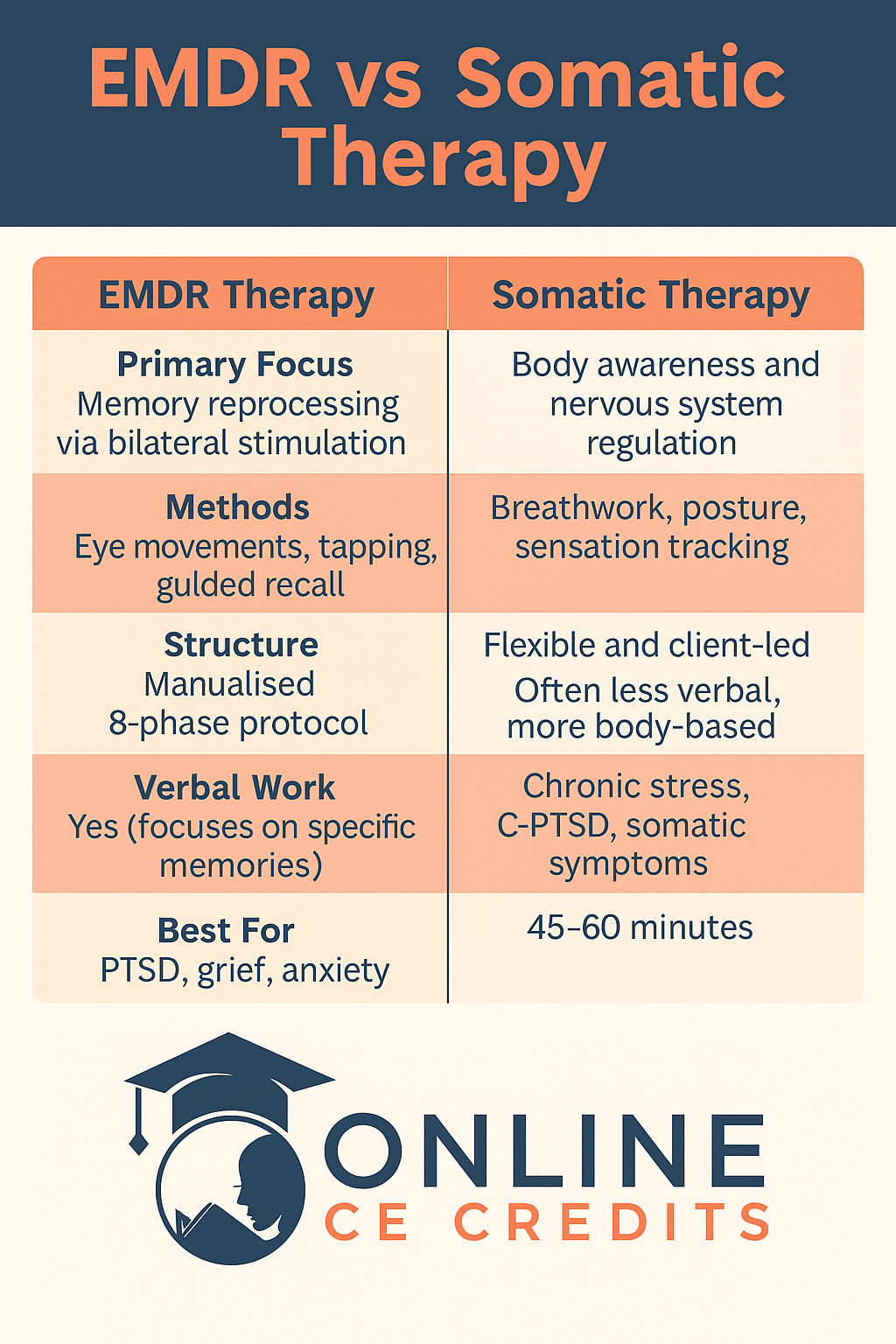
Quick Comparison Table – EMDR vs Somatic Therapy
Here is a side-by-side look at the key differences:
| Factor | EMDR Therapy | Somatic Therapy |
| Primary Focus | Memory reprocessing via bilateral stimulation | Body awareness and nervous system regulation |
| Methods | Eye movements, tapping, guided recall | Breathwork, posture, sensation tracking |
| Structure | Manualised 8-phase protocol | Flexible and client-led |
| Verbal Work | Yes (focuses on specific memories) | Often less verbal, more body-based |
| Best For | PTSD, grief, anxiety | Chronic stress, C-PTSD, somatic symptoms |
| Session Length | 60-90 minutes | 45-60 minutes |
What Is EMDR Therapy?
EMDR therapy was developed in the late 1980s by Dr. Francine Shapiro. It is best known for helping clients reprocess distressing memories through bilateral stimulation, typically eye movements, tapping, or alternating sounds.
During an EMDR session, the client recalls a traumatic memory while focusing on bilateral cues. This helps the brain integrate the memory in a more adaptive way, reducing its emotional intensity over time. The EMDR therapy follows an 8-phase protocol and does not require clients to describe the memory in detail.
EMDR is recommended by the World Health Organization, APA, and U.S. Department of Veterans Affairs as a first-line treatment for PTSD. It has also shown benefit for anxiety, grief, and phobias. For therapists looking to deepen their skills, EMDR courses and EMDR certification paths are available through Online CE Credits.

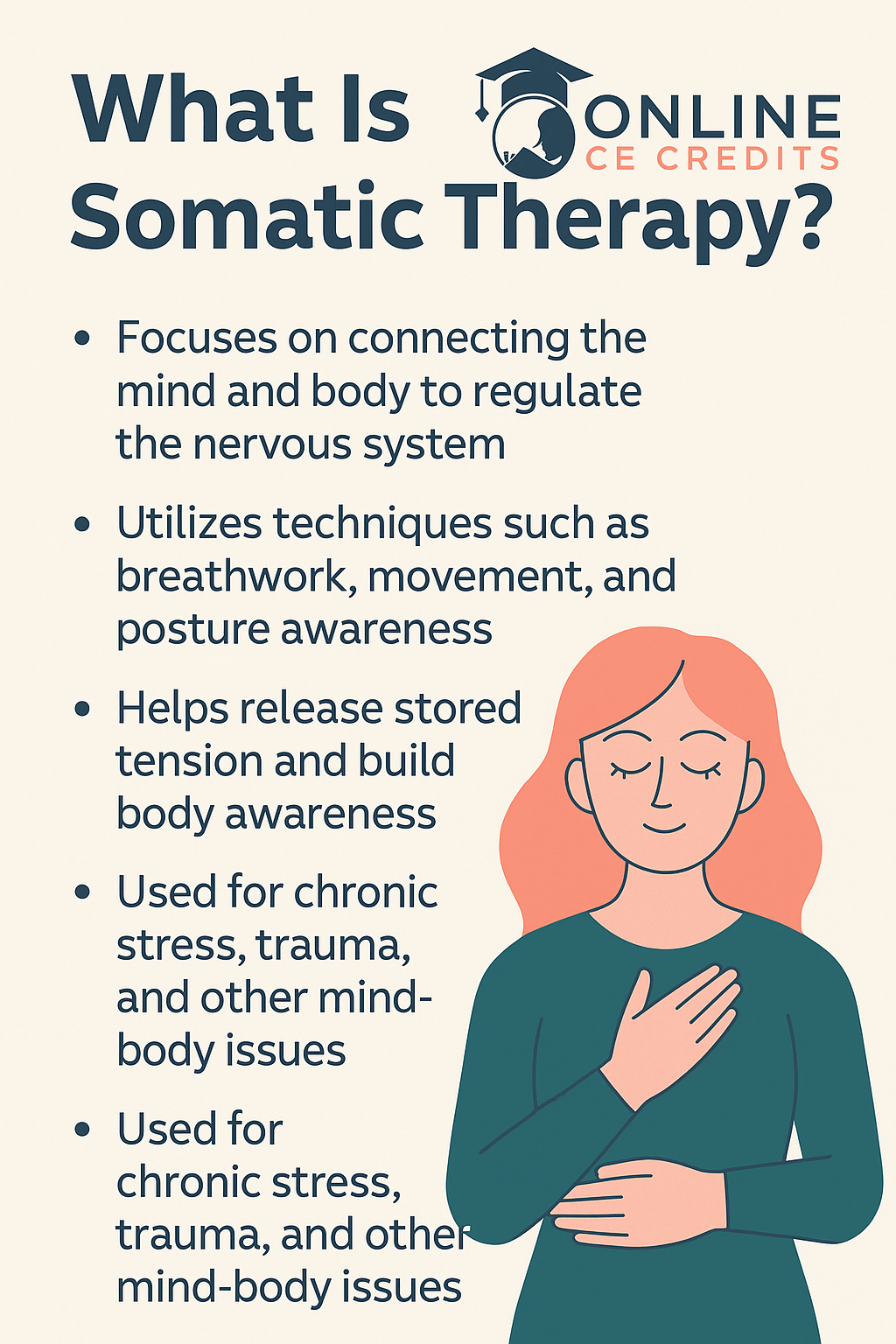
What Is Somatic Therapy?
Somatic therapy is rooted in body-centered psychotherapy. It works by helping clients tune into physical sensations, breath, and postural shifts that may reflect unprocessed trauma. Unlike EMDR, somatic work focuses on the felt sense rather than the specific narrative.
Common techniques include breathwork, grounding exercises, movement, and sensation tracking. The goal is to help clients build awareness of how trauma lives in the body and to slowly release stored tension.
Approaches like Somatic Experiencing (developed by Dr. Peter Levine) and Sensorimotor Psychotherapy (pioneered by Dr. Pat Ogden) have become increasingly popular among trauma therapists. Somatic therapy can support clients who struggle with dissociation, hypervigilance, or emotional overwhelm.
For training options, Online CE Credits offers somatic therapy courses with CE approval.
EMDR vs Somatic Therapy – Key Differences
While both EMDR and somatic therapy are trauma-informed, their methods and goals are different.
Method & Focus
EMDR targets how traumatic memories are stored in the brain. It uses bilateral stimulation to promote memory reconsolidation. The client often works through specific events in a structured sequence.
Somatic therapy focuses on body awareness and nervous system regulation. It encourages clients to explore physical sensations without needing to retell or reframe specific memories. This makes it well-suited for clients with developmental trauma or limited verbal access.
Session Experience
EMDR sessions tend to be more structured. Clients move through distinct phases, from preparation to reprocessing and integration. The work is often active and focused, with attention on cognitive shifts.
Somatic sessions are typically slower and more fluid. The therapist might guide the client to notice areas of tension, shifts in breath, or subtle changes in posture. It can feel more experiential and less cognitively demanding.
Time to Results
EMDR often shows results within 8-12 sessions for single-incident trauma. Research has shown a reduction in PTSD symptoms after just a few weeks of treatment.
Somatic therapy may take longer to show measurable change, especially with complex trauma. However, its impact on nervous system regulation, sleep, and physical symptoms is often meaningful over time. The slower pace can be more sustainable for some clients.
Read more: Prolonged Exposure vs EMDR
How to Know Which Therapy Fits Your Client Best

There is no “wrong” choice. It all comes down to how trauma shows up in the body, mind, and daily life.
Somatic therapy may be the better fit for clients who:
- Experience chronic tension, pain, or numbness linked to trauma
- Feel disconnected from their emotions or bodily sensations
- Are drawn to a body-based approach that goes beyond words
- Have tried talk therapy and sensed something deeper was left unresolved
EMDR may be more appropriate for those who:
- Struggle with specific traumatic memories or flashbacks
- Experience intrusive thoughts, nightmares, or psychological distress
- Prefer a structured, goal-oriented approach
- Want to avoid going into detail about their traumatic experiences
In many cases, client preference, pacing needs, and clinical readiness can help guide the way. It is less about finding the “best” therapy and more about choosing the one that meets the client where they are.
Continue Your Learning
Recommended Courses
Pros and Cons of Each
✅ Pros of EMDR:
- Backed by global health agencies for PTSD
- Often leads to faster symptom relief
- Follows a clear, structured protocol
- Adaptable to telehealth settings
- Can be combined with other approaches
⚠️ Cons of EMDR:
- Requires mental focus and memory recall
- May not suit clients with high dissociation
- Sessions can be emotionally intense
✅ Pros of Somatic Therapy:
- Ideal for clients disconnected from emotions or body
- Supports nervous system regulation and trauma release
- Often less cognitively demanding
- Accessible for nonverbal or body-aware clients
⚠️ Cons of Somatic Therapy:
- Research base is smaller compared to EMDR
- Progress may be slower or less linear
- Requires careful pacing with complex trauma
Can EMDR and Somatic Therapy Be Combined?
Yes, and many clinicians find they complement each other well. For example, somatic techniques can be used to ground clients before or after EMDR sessions. Clients with complex trauma may benefit from starting with somatic work to build tolerance before engaging in memory reprocessing.
An integrated approach helps therapists stay flexible and trauma-responsive. Many advanced EMDR practitioners incorporate somatic tools into their work. For those ready to deepen their training, Online CE Credits offers an Advanced EMDR Certification that includes these integrative methods.
FAQ
Is EMDR Therapy More Effective Than Somatic Therapy?
EMDR has a larger evidence base, especially for PTSD. Somatic therapy has growing support for emotional regulation and chronic trauma. The best choice depends on the client’s needs.
Can You Do EMDR and Somatic Therapy at the Same Time?
Yes. Many therapists use somatic grounding techniques alongside EMDR to improve safety, pacing, and integration.
Does EMDR Lead to Somatic De-Arousal?
Yes. EMDR often reduces physiological arousal by reprocessing stored stress. Clients may notice relaxed breathing or reduced body tension after sessions.
Can You Do Somatic Therapy Online?
Yes, though it may require adjustments. Many somatic tools, like breathwork and interoception, can be guided virtually with proper training.
How Many Sessions Does EMDR Take?
For single-event trauma, EMDR can take 8-12 sessions. Complex trauma may require more time.
Which Therapy Is Better for Complex PTSD?
Somatic therapy is often a safer starting point for complex trauma. EMDR can be introduced once regulation improves.
