
ADHD often shows up in therapy before anyone names it, hidden behind missed deadlines, strained relationships, or constant overwhelm. Therapists may recognize the pattern, yet still want stronger tools for assessment, treatment planning, and everyday clinical decisions.
If those situations feel familiar, you may be asking: Is ADHD certification worth it for therapists? The answer depends on the program, the clinician’s caseload, and the skills they need most.
Our Certificate in ADHD Assessment & Treatment combines focused coursework with consultation, helping clinicians connect new knowledge with real client care.
What Is an ADHD Certification for Therapists?
An ADHD certification is a knowledge qualifier and credibility marker showing that a clinician completed defined education and professional requirements. An ADHD certificate program provides organized training, although completing the coursework may not automatically award a professional credential.

Programs commonly cover ADHD presentations, executive function, differential diagnosis, assessment, treatment planning, and co-occurring mental health conditions. Stronger programs also examine neurodiversity-informed care and show therapists how these ideas shape real clinical decisions.
This clinical training differs from ADHD coaching certification, which usually focuses on routines, accountability, organization, and practical goals. Therapist training builds upon an existing clinical mental health license and the responsibilities connected with that profession.
Does ADHD Certification Replace Your Professional License?
No, an ADHD certification does not replace a professional license or expand a therapist’s legal scope of practice. Counselors, social workers, psychologists, and other licensed therapists must continue following their state laws and licensing board rules.
Permission to diagnose ADHD may differ from permission to conduct formal psychological testing within a particular state. A life coach or certified coach also cannot formally diagnose ADHD simply after completing ADHD coach training. Formally evaluating for and issuing a DSM diagnosis requires a clinical license appropriately scoped to provide these services in a clinical setting.
A certification credential shows additional education and focused expertise, but it never authorizes services that the clinician’s existing license does not permit.
Is an ADHD Certification Actually Worth It?
Yes, ADHD certification can be worthwhile when it addresses recurring clinical questions and fills clear gaps in therapist training. Its value comes from stronger assessment, case formulation, and treatment skills, rather than just another title for a website or directory.

Why?
1. You Can Become More Confident in Identifying ADHD Presentations
Specialized training can help therapists recognize ADHD presentations that do not involve visible or disruptive hyperactivity. Clients may instead describe procrastination, poor time management, forgetfulness, impulsive choices, emotional dysregulation, or unfinished work.
The National Institute of Mental Health describes inattentive, hyperactive-impulsive, and combined presentations that may change across different life stages.
2. It Can Improve Differential Diagnosis
Good ADHD assessment training helps clinicians ask whether the symptoms reflect ADHD, another condition, or several conditions together. Anxiety, depression, trauma, sleep problems, and learning difficulties may create attention or organization problems resembling ADHD symptoms.
3. You Can Learn More Than Basic ADHD Treatment Strategies
Many clients have already tried planners, reminders, timers, and smaller task lists before they begin therapy. These tools can help, but they rarely explain why a client remains stuck or repeatedly abandons a system.
Useful ADHD training helps therapists look beneath the missed task and understand the barrier keeping the pattern in place. That barrier might involve time blindness, emotional overwhelm, unclear steps, low motivation, or difficulty starting an uncomfortable task.
With that understanding, therapists can choose an intervention, explain its purpose, practice it collaboratively, and adjust it when needed.
4. It Can Help You Work More Effectively With Neurodivergent Clients
Neurodivergent-affirming training helps therapists adjust care around each client’s needs, strengths, preferences, and sources of distress. A client forgetting therapy homework may need guided practice, visual reminders, and a simpler plan created during sessions.
This approach supports managing ADHD without treating every difference as failure, laziness, resistance, or poor motivation.
5. It May Help You Develop an ADHD Specialty in Your Practice
Specialized training can help therapists build an ADHD focus and explain that focus clearly to potential clients or employers. For example, therapists can update their Psychology Today or other directory profiles to describe their ADHD training and the clients they support.
Some clinicians may want a formal way to show that they completed additional education and practice requirements. For those clinicians, the optional ADHD-PT™ credential can provide that professional credibility marker after they meet its separate requirements.
6. It Can Combine Clinical Learning With Continuing Education
The right certification program can support professional development while providing continuing education for license renewal. That combination becomes valuable when training hours address problems already appearing throughout the clinician’s work week.
However, therapists should judge the program through its content, CE approvals, and practical usefulness, rather than the certification credential alone.
7. It Can Strengthen Work With Families and Other Providers
ADHD treatment often reaches beyond individual therapy, especially when children, caregivers, schools, or prescribers share responsibility for daily support. Training can help therapists coordinate those efforts while keeping each person’s role and clinical boundaries clear.
For families, this coordination often includes helping caregivers respond consistently to routines, behavior challenges, and emotional needs. Behavioral parent training offers one structured way to teach those skills and support changes outside therapy sessions.
Researchers have studied whether those improvements continue after the formal parent training program has ended. A 2023 meta-analysis of 27 studies found small-to-moderate benefits in parenting and child behavior after treatment ended.
Who Is ADHD Certification Most Worth It For?
ADHD certification is most valuable for therapists who frequently face questions involving assessment, diagnosis, treatment, or executive functioning. The best fit also depends on the clinician’s population, current education, and plans for future practice.

Therapists Who Frequently Treat Adults With ADHD
Therapists serving adults need skills for late diagnosis, emotional regulation, relationships, executive function, and workplace difficulties. A CDC analysis of 2023 survey data found that 55.9% of adults reporting current ADHD received their diagnosis during adulthood.
These newly diagnosed clients may need practical support alongside space for understanding earlier struggles, shame, and missed recognition.
Therapists Working With Children and Adolescents
Child-focused therapists benefit from training that connects developmental needs with family, behavioral, and school-based interventions.
The American Academy of Pediatrics places parent training before medication for children younger than six. For older children, treatment often involves medication, behavioral care, school supports, and close communication between involved adults.
Counselors and Social Workers Seeing Neurodivergent Clients
ADHD certification for counselors can strengthen case formulation, treatment planning, and practical support within mental health counseling.
ADHD certification for social workers may deepen family work, care coordination, and attention to barriers affecting daily functioning.
For both professions, training should build upon existing clinical responsibilities rather than introduce services outside licensed practice.
Therapists Who Want ADHD as a Clinical Specialty
A therapist building an ADHD specialty needs more than a brief overview or several unrelated treatment tips. The training program should strengthen assessment, differential diagnosis, treatment planning, and support for common co-occurring concerns.
In private practice, that education can also support clearer referrals and collaboration with assessment or medication providers.
When Might an ADHD Certification NOT Be Worth It?
-
- <>
ADHD rarely appears in the caseload:
-
- A full certification program may remain unused after the initial training ends.
<>Only several CE hours are needed: One focused course may meet the clinician’s professional development goals more efficiently.
<>The credential is expected to change legal scope: Private certification cannot replace licensure or override state assessment rules.
In these situations, our individual ADHD courses may provide a better starting point for one specific clinical need.
ADHD Certification vs ADHD Continuing Education Courses
An individual ADHD course develops one skill area, while a larger program connects several parts of clinical care.
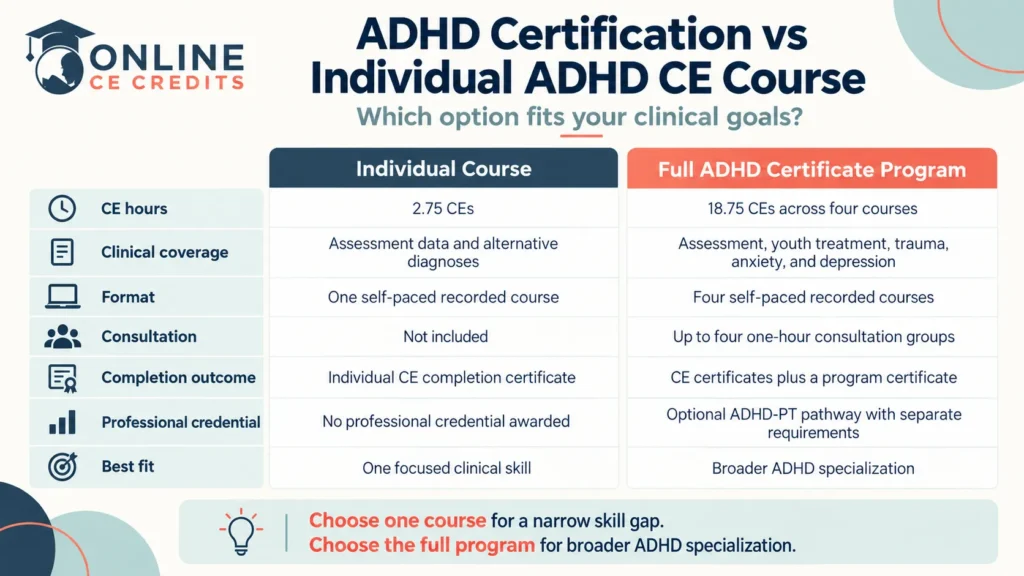
| Decision point | Individual assessment course | Full ADHD certificate program |
| CE hours | 2.75 CEs | 18.75 CEs across four courses |
| Clinical coverage | Assessment data and alternative diagnoses | Assessment, youth treatment, trauma, anxiety, and depression |
| Format | One self-paced recorded course | Four self-paced recorded courses |
| Consultation | Not listed as included | Up to four one-hour consultation groups |
| Completion outcome | Individual CE completion certificate | CE certificates and program certificate |
| Professional credential | No professional credential awarded | Optional ADHD-PT™ pathway with separate requirements |
| Best fit | One focused clinical skill | Broader ADHD specialization |
Individual ADHD continuing education may be enough when a clinician needs targeted knowledge or several renewal hours. A full ADHD certification program fits better when several connected skills need development through one organized curriculum.
What Should Therapists Look for in an ADHD Certification?
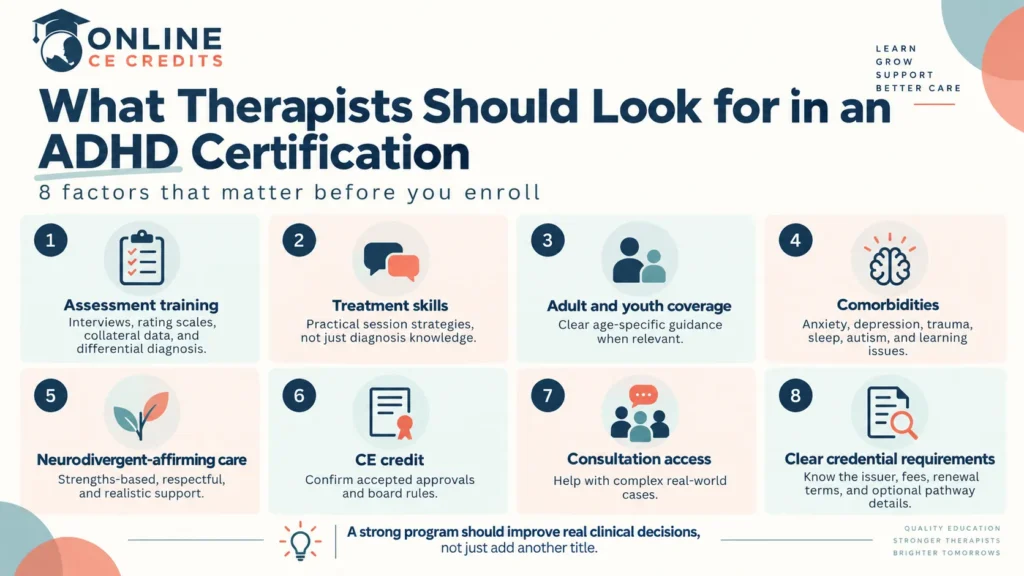
The best ADHD certification should match the clinical work that a therapist wants to perform more effectively. Clear objectives, qualified instructors, useful examples, and transparent credential requirements reveal more than just an impressive program title.
Assessment Training
Strong assessment instruction should combine interviews, developmental history, observations, rating scales, self-report, and collateral information. It should also explain what happens when parents, teachers, partners, or test results present conflicting information.
Treatment Skills, Not Just Diagnosis
A worthwhile program should answer the question that follows assessment: what should happen during actual therapy sessions?
Treatment instruction should connect findings with goals, practical strategies, progress measures, and changes when an approach stalls.
Adult AND Child/Adolescent ADHD
Clinicians serving broad age ranges need training that explains how ADHD care changes throughout development. Children may need caregiver involvement and school planning, while adults often bring employment, relationship, and household concerns.
Programs should describe their age-specific lessons clearly because broad audience claims do not always reflect equal clinical depth.
Comorbidities and Differential Diagnosis
Training should give anxiety, depression, and trauma serious attention because these concerns frequently complicate ADHD presentations. Sleep problems, substance use, autism, learning difficulties, and other conditions may also affect assessment and treatment priorities.
Neurodivergent-Affirming Training
Neurodivergent-affirming care should shape the program’s language, treatment goals, clinical examples, and suggested interventions. Therapists should learn to explore overwhelm, sensory needs, motivation, and environmental barriers before labeling behavior as resistance.
A strengths-based approach can recognize creativity and persistence while still respecting disability, frustration, and genuine support needs.
Continuing Education Credit
Therapists should confirm scope of practice eligibility, CE provider acceptance, and delivery format restrictions directly with their state licensing board.
At Online CE Credits, we hold NBCC and ASWB provider approvals, with exact approval details provided for individual courses.
Access to Consultation
Consultation lets clinicians discuss the difficult questions that often appear after finishing a recorded ADHD course. These questions may involve conflicting reports, family disagreements, unclear diagnoses, or interventions that have stopped helping.
Our program includes access to four one-hour consultation groups, although the optional credential carries additional consultation requirements.
Ongoing Access to the Training
Continued access matters because clinicians rarely remember every detail from an 18.75-hour program after one viewing. A therapist may revisit assessment material before an evaluation or review family strategies before meeting caregivers.
Our program includes lifetime content access, allowing clinicians to return when later cases make earlier lessons relevant.
Clear Certification Requirements and Renewal Costs
Credential requirements should explain who qualifies, who issues certification, and what work follows the training program. Therapists should also check application fees, practice requirements, consultation hours, expiration terms, and maintenance costs.
How Much Time Does an ADHD Certification Take?
ADHD certification can take several weeks or months, depending on its coursework, practice, consultation, and application requirements.
Our online ADHD training provides 18.75 CE hours, with roughly 20 self-paced hours estimated for the educational program.
That estimate covers completion of the four training courses, rather than the additional practical requirements wrapped inside the optional ADHD-PT™ professional credential. The complete credential requires reading, practice sessions, consultation, case conceptualization, and an application through our independent certification body, Mind Works Continuing Education, LLC.
CE totals should not be confused with clinical contact hours, coaching hours, or direct client experience. Because the courses are self-paced, clinicians can complete the training around sessions, clinical documentation, and family responsibilities.
What Do You Learn in Online CE Credits’ ADHD Certificate Program?
Our program connects assessment, youth treatment, trauma, anxiety, depression, and affirming care through four related courses.
Together, they provide 18.75 CEs and practical guidance for decisions clinicians face during assessment and therapy.
ADHD Assessment
Good ADHD assessment begins with a simple question: what does each piece of information reveal about the client?
Clinicians learn to gather details through interviews, personal history, observations, self-reports, collateral ratings, and continuous performance data.
From there, the training explains how to compare findings, notice conflicts, and avoid relying on one test alone. The 2.75-CE ADHD assessment course also explores alternative diagnoses and the need for referral or further evaluation.
ADHD Treatment in Children and Adolescents
Working with younger clients requires more than adapting adult ADHD strategies for a smaller person. Children and adolescents depend on caregivers, school routines, and developmental supports that shape treatment outside the therapy room.
The 5.25-CE child and adolescent ADHD treatment course helps clinicians understand assessment, executive functioning, medication, and research-supported interventions. It then connects those ideas with practical family strategies that caregivers can use during ordinary daily challenges.
School coordination receives attention because children often benefit when therapy, home, and classroom expectations support one another.
Trauma and ADHD
ADHD affects much more than attention, especially after years of criticism, frustration, or repeated feelings of failure. Those experiences can shape identity, relationships, emotional regulation, motivation, and the way clients respond during treatment.
The five-CE trauma-informed ADHD course helps therapists explore those connections without assuming that every ADHD difficulty comes from trauma. Clinicians also learn supportive approaches to accountability, routines, self-understanding, and emotional safety throughout the therapeutic process.
For clinicians mainly treating adults, the separate 2.5-CE adult ADHD treatment course explores shame, motivation, executive-function challenges, and trauma-related patterns.
ADHD With Anxiety and Depression
Attention problems rarely arrive alone, which can make treatment decisions harder when anxiety or depression is also present. A client may procrastinate because a task feels unclear, failure feels frightening, or depression has reduced their energy.
The 5.75-CE ADHD, depression, and anxiety course helps clinicians separate these overlapping patterns before choosing a treatment direction. Therapists then explore emotional safety, cognitive reframing, self-criticism, procrastination, and accommodations for executive-function needs during everyday life.
The course also explains when additional testing or referral may provide the clarity needed for responsible care.
Neurodivergent-Affirming Treatment
Across every module, clinicians are encouraged to understand ADHD without reducing clients to a list of deficits. That approach includes recognizing real challenges while respecting each client’s strengths, preferences, goals, and lived experience.
Therapists learn how shame, stigma, emotional regulation, and environmental demands can affect a client’s participation in treatment. They also explore practical supports that make therapy easier to follow, including clearer tasks and more flexible strategies.
By carrying this perspective across the program, clinicians can offer care that feels useful, respectful, and realistic.
What Do Therapists Get With the Online CE Credits ADHD Program?
The next complicated ADHD case may arrive before a therapist finds time for another training weekend. Our ADHD certificate program combines focused education, flexible study, and consultation for a current one-time tuition of $562.50.
-
- <>
18.75 CE hours:
-
- Earn continuing education that may support license renewal where the courses are accepted.
<>Four specialized ADHD courses: Study assessment, youth treatment, trauma, anxiety, and depression within one connected program.
<>Self-paced online learning: Complete each course around client sessions, documentation, family needs, and practice responsibilities.
<>Four consultation groups: Attend up to four included one-hour groups for help applying training to difficult clinical questions.
<>Optional ADHD-PT™ credential: Eligible clinicians may apply through Mind Works after completing every separate certification requirement.
<>Lifetime training access: Return to course materials when new ADHD clients raise questions or earlier details need refreshing.
<>Installment payment option: Divide the program cost across scheduled payments while receiving access after the first installment.
Certificate Program enrollment includes the certification fee for clinicians who desire to optionally pursue the post nominal certification credential and digital badge through MWCE, LLC. Other costs may still arise while completing books, outside consultation, or remaining professional requirements.
Is the ADHD-PT™ Credential the Same as a License?
No, ADHD-PT™ is a private professional knowledge credential and does not replace a state-issued mental health license. We provide the coursework, CE completion certificates, and the program level certificate after completion of the full Certificate Program.
For those who desire to pursue full certification, Mind Works Continuing Education, LLC awards the optional ADHD-PT™ credential after reviewing its separate professional requirements. MWCE, LLC is a separate legal entity backed by a 20+ person advisory board. It is owned by Online CE Credits and manages its own certification standards.
The credential does not authorize new services, override licensing laws, or guarantee competence with every ADHD presentation.
So, Is ADHD Certification Worth It for Therapists?
Yes, ADHD certification may be worthwhile when ADHD already appears regularly within a therapist’s clinical work. It can also support clinicians who want ADHD treatment to become a thoughtful, well-developed area of practice.
The value depends on what the program teaches and how often those skills will support actual clients. Therapists needing several CE hours or one focused skill may find an individual ADHD course more practical.
For deeper study, our program combines 18.75 CEs, self-paced education, consultation access, and an optional credential pathway.
Explore the Certificate in ADHD Assessment & Treatment and compare the curriculum with current caseload clinical needs.
FAQ
What are the requirements for ADHD certification for therapists?
Each issuer sets its own standards, so the exact requirements depend on the credential being pursued.
Mind Works requires an active license, 18 qualifying CE hours, exams, practice, consultation, casework, and a capstone.
What should ADHD assessment training for therapists include?
Look for training on interviews, developmental history, attentional assessment, rating scales, observations, collateral reports, impairment, and differential diagnosis. It should explain how clinicians compare evidence across settings instead of treating one screening score as confirmation.
Is adult ADHD training different from training for children and adolescents?
Yes, because clients face different challenges and need different forms of support throughout each developmental stage. Adult education covers work, relationships, late diagnosis, and masking, while youth training emphasizes caregivers, schools, and behavior plans.
Do ADHD certification programs teach differential diagnosis?
Many programs cover it, although therapists should confirm the topic within the published learning objectives. Strong instruction compares ADHD with anxiety, depression, trauma, sleep problems, learning differences, and other possible explanations.
Does ADHD certification include continuing education credits for therapists?
Some programs provide CE credit, while others require applicants to complete approved education through another provider. Our program awards 18.75 NBCC and ASWB approved CEs after clinicians complete every lesson, quiz, and required course evaluation.
Can ADHD certification help therapists work with adult ADHD clients?
Yes, when the curriculum addresses adult assessment, executive functioning, emotional regulation, and common co-occurring conditions. Its practical value increases when therapists combine that education with consultation and continued clinical practice.
What is the difference between ADHD training and an ADHD certification course?
A single training course usually covers one topic, while certification follows a broader pathway with defined requirements. Coach training emphasizes routines and accountability, while clinical programs prepare licensed therapists for assessment and mental health treatment.
