loading...
by Jennifer Sweeton, PsyD, JD, MS, MA | Sep 11, 2026 | Certificate, Educational
ADHD often shows up in therapy before anyone names it, hidden behind missed deadlines, strained relationships, or constant overwhelm. Therapists may recognize the pattern, yet still want stronger tools for assessment, treatment planning, and everyday clinical decisions.
If those situations feel familiar, you may be asking: Is ADHD certification worth it for therapists? The answer depends on the program, the clinician’s caseload, and the skills they need most.
Our Certificate in ADHD Assessment & Treatment combines focused coursework with consultation, helping clinicians connect new knowledge with real client care.
What Is an ADHD Certification for Therapists?
An ADHD certification is a knowledge qualifier and credibility marker showing that a clinician completed defined education and professional requirements. An ADHD certificate program provides organized training, although completing the coursework may not automatically award a professional credential.

Programs commonly cover ADHD presentations, executive function, differential diagnosis, assessment, treatment planning, and co-occurring mental health conditions. Stronger programs also examine neurodiversity-informed care and show therapists how these ideas shape real clinical decisions.
This clinical training differs from ADHD coaching certification, which usually focuses on routines, accountability, organization, and practical goals. Therapist training builds upon an existing clinical mental health license and the responsibilities connected with that profession.
Does ADHD Certification Replace Your Professional License?
No, an ADHD certification does not replace a professional license or expand a therapist’s legal scope of practice. Counselors, social workers, psychologists, and other licensed therapists must continue following their state laws and licensing board rules.
Permission to diagnose ADHD may differ from permission to conduct formal psychological testing within a particular state. A life coach or certified coach also cannot formally diagnose ADHD simply after completing ADHD coach training. Formally evaluating for and issuing a DSM diagnosis requires a clinical license appropriately scoped to provide these services in a clinical setting.
A certification credential shows additional education and focused expertise, but it never authorizes services that the clinician’s existing license does not permit.
Is an ADHD Certification Actually Worth It?
Yes, ADHD certification can be worthwhile when it addresses recurring clinical questions and fills clear gaps in therapist training. Its value comes from stronger assessment, case formulation, and treatment skills, rather than just another title for a website or directory.

Why?
1. You Can Become More Confident in Identifying ADHD Presentations
Specialized training can help therapists recognize ADHD presentations that do not involve visible or disruptive hyperactivity. Clients may instead describe procrastination, poor time management, forgetfulness, impulsive choices, emotional dysregulation, or unfinished work.
The National Institute of Mental Health describes inattentive, hyperactive-impulsive, and combined presentations that may change across different life stages.
2. It Can Improve Differential Diagnosis
Good ADHD assessment training helps clinicians ask whether the symptoms reflect ADHD, another condition, or several conditions together. Anxiety, depression, trauma, sleep problems, and learning difficulties may create attention or organization problems resembling ADHD symptoms.
3. You Can Learn More Than Basic ADHD Treatment Strategies
Many clients have already tried planners, reminders, timers, and smaller task lists before they begin therapy. These tools can help, but they rarely explain why a client remains stuck or repeatedly abandons a system.
Useful ADHD training helps therapists look beneath the missed task and understand the barrier keeping the pattern in place. That barrier might involve time blindness, emotional overwhelm, unclear steps, low motivation, or difficulty starting an uncomfortable task.
With that understanding, therapists can choose an intervention, explain its purpose, practice it collaboratively, and adjust it when needed.
4. It Can Help You Work More Effectively With Neurodivergent Clients
Neurodivergent-affirming training helps therapists adjust care around each client’s needs, strengths, preferences, and sources of distress. A client forgetting therapy homework may need guided practice, visual reminders, and a simpler plan created during sessions.
This approach supports managing ADHD without treating every difference as failure, laziness, resistance, or poor motivation.
5. It May Help You Develop an ADHD Specialty in Your Practice
Specialized training can help therapists build an ADHD focus and explain that focus clearly to potential clients or employers. For example, therapists can update their Psychology Today or other directory profiles to describe their ADHD training and the clients they support.
Some clinicians may want a formal way to show that they completed additional education and practice requirements. For those clinicians, the optional ADHD-PT™ credential can provide that professional credibility marker after they meet its separate requirements.
6. It Can Combine Clinical Learning With Continuing Education
The right certification program can support professional development while providing continuing education for license renewal. That combination becomes valuable when training hours address problems already appearing throughout the clinician’s work week.
However, therapists should judge the program through its content, CE approvals, and practical usefulness, rather than the certification credential alone.
7. It Can Strengthen Work With Families and Other Providers
ADHD treatment often reaches beyond individual therapy, especially when children, caregivers, schools, or prescribers share responsibility for daily support. Training can help therapists coordinate those efforts while keeping each person’s role and clinical boundaries clear.
For families, this coordination often includes helping caregivers respond consistently to routines, behavior challenges, and emotional needs. Behavioral parent training offers one structured way to teach those skills and support changes outside therapy sessions.
Researchers have studied whether those improvements continue after the formal parent training program has ended. A 2023 meta-analysis of 27 studies found small-to-moderate benefits in parenting and child behavior after treatment ended.
Who Is ADHD Certification Most Worth It For?
ADHD certification is most valuable for therapists who frequently face questions involving assessment, diagnosis, treatment, or executive functioning. The best fit also depends on the clinician’s population, current education, and plans for future practice.

Therapists Who Frequently Treat Adults With ADHD
Therapists serving adults need skills for late diagnosis, emotional regulation, relationships, executive function, and workplace difficulties. A CDC analysis of 2023 survey data found that 55.9% of adults reporting current ADHD received their diagnosis during adulthood.
These newly diagnosed clients may need practical support alongside space for understanding earlier struggles, shame, and missed recognition.
Therapists Working With Children and Adolescents
Child-focused therapists benefit from training that connects developmental needs with family, behavioral, and school-based interventions.
The American Academy of Pediatrics places parent training before medication for children younger than six. For older children, treatment often involves medication, behavioral care, school supports, and close communication between involved adults.
Counselors and Social Workers Seeing Neurodivergent Clients
ADHD certification for counselors can strengthen case formulation, treatment planning, and practical support within mental health counseling.
ADHD certification for social workers may deepen family work, care coordination, and attention to barriers affecting daily functioning.
For both professions, training should build upon existing clinical responsibilities rather than introduce services outside licensed practice.
Therapists Who Want ADHD as a Clinical Specialty
A therapist building an ADHD specialty needs more than a brief overview or several unrelated treatment tips. The training program should strengthen assessment, differential diagnosis, treatment planning, and support for common co-occurring concerns.
In private practice, that education can also support clearer referrals and collaboration with assessment or medication providers.
When Might an ADHD Certification NOT Be Worth It?
ADHD rarely appears in the caseload:
-
A full certification program may remain unused after the initial training ends.
<>Only several CE hours are needed: One focused course may meet the clinician’s professional development goals more efficiently.
<>The credential is expected to change legal scope: Private certification cannot replace licensure or override state assessment rules.
In these situations, our individual ADHD courses may provide a better starting point for one specific clinical need.
ADHD Certification vs ADHD Continuing Education Courses
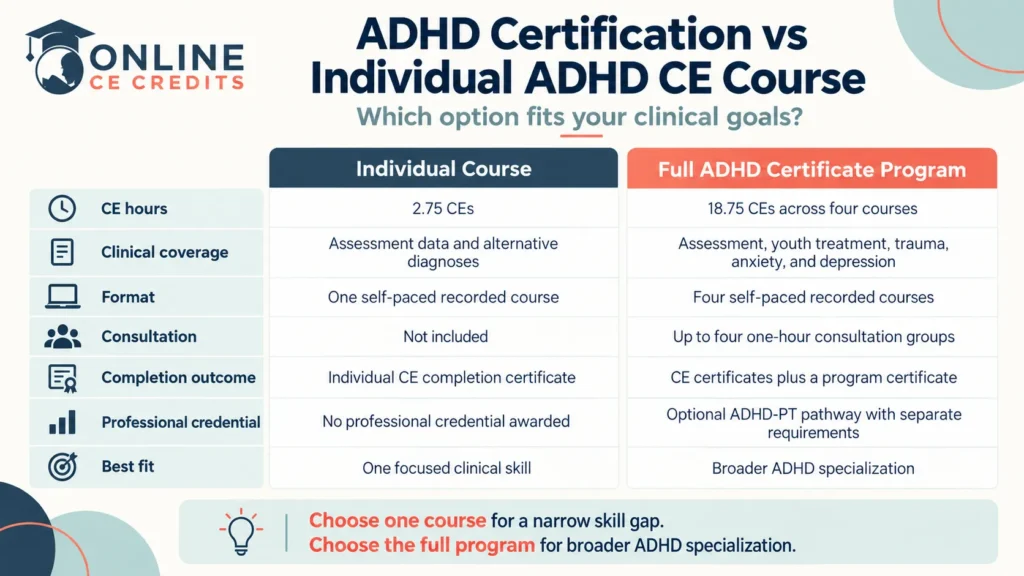
An individual ADHD course develops one skill area, while a larger program connects several parts of clinical care.
| Decision point |
Individual assessment course |
Full ADHD certificate program |
| CE hours |
2.75 CEs |
18.75 CEs across four courses |
| Clinical coverage |
Assessment data and alternative diagnoses |
Assessment, youth treatment, trauma, anxiety, and depression |
| Format |
One self-paced recorded course |
Four self-paced recorded courses |
| Consultation |
Not listed as included |
Up to four one-hour consultation groups |
| Completion outcome |
Individual CE completion certificate |
CE certificates and program certificate |
| Professional credential |
No professional credential awarded |
Optional ADHD-PT™ pathway with separate requirements |
| Best fit |
One focused clinical skill |
Broader ADHD specialization |
Individual ADHD continuing education may be enough when a clinician needs targeted knowledge or several renewal hours. A full ADHD certification program fits better when several connected skills need development through one organized curriculum.
What Should Therapists Look for in an ADHD Certification?
The best ADHD certification should match the clinical work that a therapist wants to perform more effectively. Clear objectives, qualified instructors, useful examples, and transparent credential requirements reveal more than just an impressive program title.
Assessment Training
Strong assessment instruction should combine interviews, developmental history, observations, rating scales, self-report, and collateral information. It should also explain what happens when parents, teachers, partners, or test results present conflicting information.
Treatment Skills, Not Just Diagnosis
A worthwhile program should answer the question that follows assessment: what should happen during actual therapy sessions?
Treatment instruction should connect findings with goals, practical strategies, progress measures, and changes when an approach stalls.
Adult AND Child/Adolescent ADHD
Clinicians serving broad age ranges need training that explains how ADHD care changes throughout development. Children may need caregiver involvement and school planning, while adults often bring employment, relationship, and household concerns.
Programs should describe their age-specific lessons clearly because broad audience claims do not always reflect equal clinical depth.
Comorbidities and Differential Diagnosis
Training should give anxiety, depression, and trauma serious attention because these concerns frequently complicate ADHD presentations. Sleep problems, substance use, autism, learning difficulties, and other conditions may also affect assessment and treatment priorities.
Neurodivergent-Affirming Training
Neurodivergent-affirming care should shape the program’s language, treatment goals, clinical examples, and suggested interventions. Therapists should learn to explore overwhelm, sensory needs, motivation, and environmental barriers before labeling behavior as resistance.
A strengths-based approach can recognize creativity and persistence while still respecting disability, frustration, and genuine support needs.
Continuing Education Credit
Therapists should confirm scope of practice eligibility, CE provider acceptance, and delivery format restrictions directly with their state licensing board.
At Online CE Credits, we hold NBCC and ASWB provider approvals, with exact approval details provided for individual courses.
Access to Consultation
Consultation lets clinicians discuss the difficult questions that often appear after finishing a recorded ADHD course. These questions may involve conflicting reports, family disagreements, unclear diagnoses, or interventions that have stopped helping.
Our program includes access to four one-hour consultation groups, although the optional credential carries additional consultation requirements.
Ongoing Access to the Training
Continued access matters because clinicians rarely remember every detail from an 18.75-hour program after one viewing. A therapist may revisit assessment material before an evaluation or review family strategies before meeting caregivers.
Our program includes lifetime content access, allowing clinicians to return when later cases make earlier lessons relevant.
Clear Certification Requirements and Renewal Costs
Credential requirements should explain who qualifies, who issues certification, and what work follows the training program. Therapists should also check application fees, practice requirements, consultation hours, expiration terms, and maintenance costs.
How Much Time Does an ADHD Certification Take?
ADHD certification can take several weeks or months, depending on its coursework, practice, consultation, and application requirements.
Our online ADHD training provides 18.75 CE hours, with roughly 20 self-paced hours estimated for the educational program.
That estimate covers completion of the four training courses, rather than the additional practical requirements wrapped inside the optional ADHD-PT™ professional credential. The complete credential requires reading, practice sessions, consultation, case conceptualization, and an application through our independent certification body, Mind Works Continuing Education, LLC.
CE totals should not be confused with clinical contact hours, coaching hours, or direct client experience. Because the courses are self-paced, clinicians can complete the training around sessions, clinical documentation, and family responsibilities.
What Do You Learn in Online CE Credits’ ADHD Certificate Program?
Our program connects assessment, youth treatment, trauma, anxiety, depression, and affirming care through four related courses.
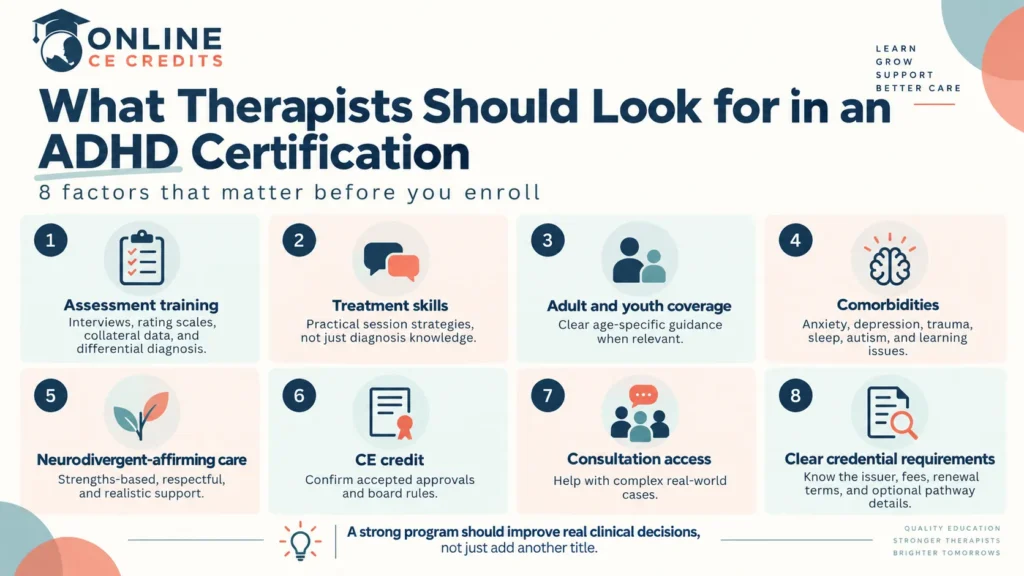
Together, they provide 18.75 CEs and practical guidance for decisions clinicians face during assessment and therapy.
ADHD Assessment
Good ADHD assessment begins with a simple question: what does each piece of information reveal about the client?
Clinicians learn to gather details through interviews, personal history, observations, self-reports, collateral ratings, and continuous performance data.
From there, the training explains how to compare findings, notice conflicts, and avoid relying on one test alone. The 2.75-CE ADHD assessment course also explores alternative diagnoses and the need for referral or further evaluation.
ADHD Treatment in Children and Adolescents
Working with younger clients requires more than adapting adult ADHD strategies for a smaller person. Children and adolescents depend on caregivers, school routines, and developmental supports that shape treatment outside the therapy room.
The 5.25-CE child and adolescent ADHD treatment course helps clinicians understand assessment, executive functioning, medication, and research-supported interventions. It then connects those ideas with practical family strategies that caregivers can use during ordinary daily challenges.
School coordination receives attention because children often benefit when therapy, home, and classroom expectations support one another.
Trauma and ADHD
ADHD affects much more than attention, especially after years of criticism, frustration, or repeated feelings of failure. Those experiences can shape identity, relationships, emotional regulation, motivation, and the way clients respond during treatment.
The five-CE trauma-informed ADHD course helps therapists explore those connections without assuming that every ADHD difficulty comes from trauma. Clinicians also learn supportive approaches to accountability, routines, self-understanding, and emotional safety throughout the therapeutic process.
For clinicians mainly treating adults, the separate 2.5-CE adult ADHD treatment course explores shame, motivation, executive-function challenges, and trauma-related patterns.
ADHD With Anxiety and Depression
Attention problems rarely arrive alone, which can make treatment decisions harder when anxiety or depression is also present. A client may procrastinate because a task feels unclear, failure feels frightening, or depression has reduced their energy.
The 5.75-CE ADHD, depression, and anxiety course helps clinicians separate these overlapping patterns before choosing a treatment direction. Therapists then explore emotional safety, cognitive reframing, self-criticism, procrastination, and accommodations for executive-function needs during everyday life.
The course also explains when additional testing or referral may provide the clarity needed for responsible care.
Neurodivergent-Affirming Treatment
Across every module, clinicians are encouraged to understand ADHD without reducing clients to a list of deficits. That approach includes recognizing real challenges while respecting each client’s strengths, preferences, goals, and lived experience.
Therapists learn how shame, stigma, emotional regulation, and environmental demands can affect a client’s participation in treatment. They also explore practical supports that make therapy easier to follow, including clearer tasks and more flexible strategies.
By carrying this perspective across the program, clinicians can offer care that feels useful, respectful, and realistic.
What Do Therapists Get With the Online CE Credits ADHD Program?
The next complicated ADHD case may arrive before a therapist finds time for another training weekend. Our ADHD certificate program combines focused education, flexible study, and consultation for a current one-time tuition of $562.50.
18.75 CE hours:
-
Earn continuing education that may support license renewal where the courses are accepted.
<>Four specialized ADHD courses: Study assessment, youth treatment, trauma, anxiety, and depression within one connected program.
<>Self-paced online learning: Complete each course around client sessions, documentation, family needs, and practice responsibilities.
<>Four consultation groups: Attend up to four included one-hour groups for help applying training to difficult clinical questions.
<>Optional ADHD-PT™ credential: Eligible clinicians may apply through Mind Works after completing every separate certification requirement.
<>Lifetime training access: Return to course materials when new ADHD clients raise questions or earlier details need refreshing.
<>Installment payment option: Divide the program cost across scheduled payments while receiving access after the first installment.
Certificate Program enrollment includes the certification fee for clinicians who desire to optionally pursue the post nominal certification credential and digital badge through MWCE, LLC. Other costs may still arise while completing books, outside consultation, or remaining professional requirements.
Is the ADHD-PT™ Credential the Same as a License?
No, ADHD-PT™ is a private professional knowledge credential and does not replace a state-issued mental health license. We provide the coursework, CE completion certificates, and the program level certificate after completion of the full Certificate Program.
For those who desire to pursue full certification, Mind Works Continuing Education, LLC awards the optional ADHD-PT™ credential after reviewing its separate professional requirements. MWCE, LLC is a separate legal entity backed by a 20+ person advisory board. It is owned by Online CE Credits and manages its own certification standards.
The credential does not authorize new services, override licensing laws, or guarantee competence with every ADHD presentation.
So, Is ADHD Certification Worth It for Therapists?
Yes, ADHD certification may be worthwhile when ADHD already appears regularly within a therapist’s clinical work. It can also support clinicians who want ADHD treatment to become a thoughtful, well-developed area of practice.
The value depends on what the program teaches and how often those skills will support actual clients. Therapists needing several CE hours or one focused skill may find an individual ADHD course more practical.
For deeper study, our program combines 18.75 CEs, self-paced education, consultation access, and an optional credential pathway.
Explore the Certificate in ADHD Assessment & Treatment and compare the curriculum with current caseload clinical needs.
FAQ
What are the requirements for ADHD certification for therapists?
Each issuer sets its own standards, so the exact requirements depend on the credential being pursued.
Mind Works requires an active license, 18 qualifying CE hours, exams, practice, consultation, casework, and a capstone.
What should ADHD assessment training for therapists include?
Look for training on interviews, developmental history, attentional assessment, rating scales, observations, collateral reports, impairment, and differential diagnosis. It should explain how clinicians compare evidence across settings instead of treating one screening score as confirmation.
Is adult ADHD training different from training for children and adolescents?
Yes, because clients face different challenges and need different forms of support throughout each developmental stage. Adult education covers work, relationships, late diagnosis, and masking, while youth training emphasizes caregivers, schools, and behavior plans.
Do ADHD certification programs teach differential diagnosis?
Many programs cover it, although therapists should confirm the topic within the published learning objectives. Strong instruction compares ADHD with anxiety, depression, trauma, sleep problems, learning differences, and other possible explanations.
Does ADHD certification include continuing education credits for therapists?
Some programs provide CE credit, while others require applicants to complete approved education through another provider. Our program awards 18.75 NBCC and ASWB approved CEs after clinicians complete every lesson, quiz, and required course evaluation.
Can ADHD certification help therapists work with adult ADHD clients?
Yes, when the curriculum addresses adult assessment, executive functioning, emotional regulation, and common co-occurring conditions. Its practical value increases when therapists combine that education with consultation and continued clinical practice.
What is the difference between ADHD training and an ADHD certification course?
A single training course usually covers one topic, while certification follows a broader pathway with defined requirements. Coach training emphasizes routines and accountability, while clinical programs prepare licensed therapists for assessment and mental health treatment.

by Tim Cassidy, MBA, MA, LPC | Aug 20, 2024 | Educational
Clinical Supervision CEUs for Social Workers: Requirements, Training & Courses
Clinical supervision is more than reviewing cases or signing off on hours. Social work supervisors are responsible for helping supervisees develop clinical judgment, practice ethically, maintain appropriate boundaries, document their work, and respond to difficult situations.
That is why some licensing boards require supervisors to complete continuing education specifically related to supervision.
If you are currently supervising social workers—or preparing to become an approved clinical supervisor—social work supervision CEUs can help you strengthen those skills while meeting applicable continuing education requirements.
Requirements vary considerably by state, so the first step is understanding what your licensing board actually requires.
What Are Social Work Supervision CEUs?
Social work supervision CEUs are continuing education courses focused specifically on the knowledge and skills needed to supervise other social workers.

Depending on the course, supervision training may address:
- Clinical supervision models
- Supervisor and supervisee responsibilities
- Ethics and professional boundaries
- Documentation
- Evaluation and feedback
- Liability and risk management
- Cultural competence
- Conflict resolution
- Telehealth supervision
- Scope of practice
- Gatekeeping and competency
- Managing difficult supervisory situations
The terms CEUs, CE credits, CE hours, and continuing education hours are sometimes used interchangeably in everyday conversation, but your licensing board may define them differently. Always follow the terminology and calculation method used by your board.
If you are an LCSW looking for broader renewal information, see our LCSW continuing education guide.
Do Social Work Supervisors Need Continuing Education?
Some do.
Supervision requirements are established by individual state licensing boards rather than by one national rule.
The Association of Social Work Boards (ASWB) reported in its 2024 comparison of clinical social work supervisor requirements that 19 jurisdictions had continuing education requirements specifically for clinical supervisors. Requirements differed in both the number of hours and how often those hours had to be completed.
That means becoming or remaining an approved clinical supervisor may require additional training beyond the general CE hours you already complete for social work license renewal.
Your state may require supervision education:
- Before becoming an approved supervisor
- During each license renewal period
- Every several years
- As part of an initial supervision training requirement
- In a particular subject area related to clinical supervision
Other jurisdictions may not require separate supervisor CE at all.
Before enrolling, check your social work continuing education requirements by state and confirm current supervision rules directly with your licensing board.
How Many Supervision CEUs Do Social Workers Need?
There is no universal number of supervision CEUs required for social workers.

Requirements depend on your jurisdiction, license level, supervisor status, and renewal cycle.
For example, some jurisdictions require only a few hours of supervision-specific continuing education during a renewal period, while others require more substantial initial supervisor training or recurring education.
According to ASWB’s comparison of clinical supervisor requirements, jurisdictions with supervision-specific CE requirements vary considerably in how those requirements are structured.
Before choosing a course, verify:
- How many supervision hours you need
- Whether the requirement is one-time or recurring
- Your renewal deadline
- Whether online training is accepted
- Whether asynchronous courses are accepted
- Whether live or interactive training is required
- What topics qualify as supervision education
- Which CE providers your board accepts
Do not assume that a course counts simply because “clinical supervision” appears in its title. Your licensing board has final authority over what satisfies your requirement.
What Counts as Clinical Supervision Continuing Education?
A qualifying supervision course should focus substantially on the responsibilities, skills, ethics, and practice of supervising other professionals.
Depending on state rules, acceptable topics may include:
- Models and theories of clinical supervision
- Developing supervision plans
- Supervisor-supervisee relationships
- Evaluation of supervisee competency
- Giving corrective feedback
- Ethical decision-making
- Professional boundaries
- Documentation requirements
- Supervisor liability
- Cultural responsiveness in supervision
- Managing impairment or competency concerns
- Telehealth and remote supervision
- Confidentiality
- Scope of practice
- Crisis and risk management
- Supervisory conflicts
General clinical courses are not automatically supervision courses.
For example, a three-hour trauma treatment course may count toward your general clinical CE requirement but may not satisfy a board requirement for three hours specifically in supervision.
That distinction is important when you are planning your renewal.
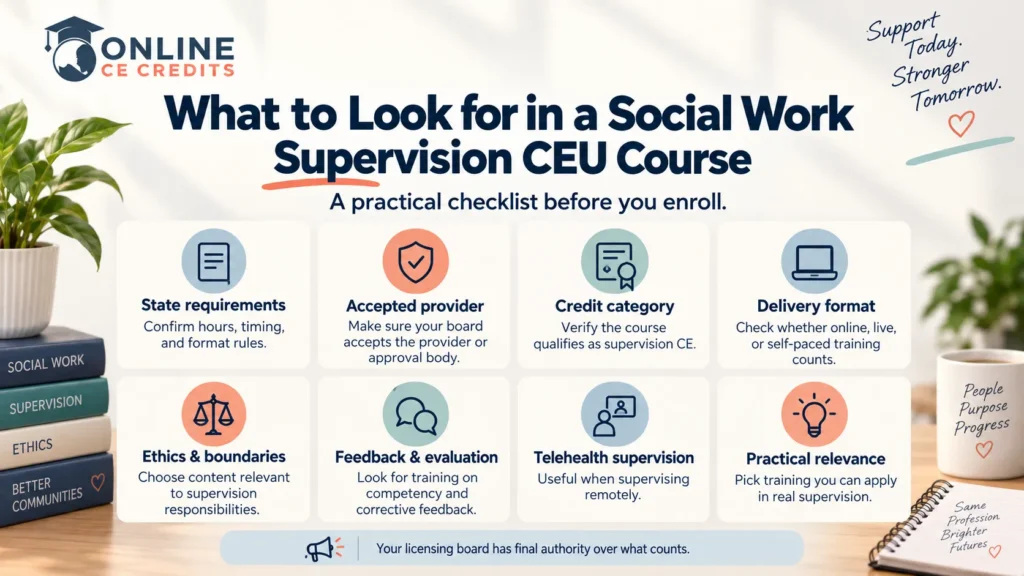
What Should Social Work Supervision Training Cover?
Strong supervision training should prepare you for the situations that make supervision difficult—not simply review definitions.
Ethics and Professional Responsibilities
Supervisors have responsibilities to supervisees, clients, employers, licensing boards, and the profession.
Training should address issues such as confidentiality, informed consent, documentation, boundaries, competence, dual relationships, scope of practice, and handling potential ethical violations.
If ethics hours are also part of your renewal requirements, explore ethics CE courses for mental health professionals.
Evaluation and Feedback
Clinical supervisors must be able to identify strengths as well as areas where a supervisee needs further development.
Effective supervision training should cover:
- Setting expectations
- Assessing competency
- Giving actionable feedback
- Documenting progress
- Responding to recurring problems
- Developing remediation plans when necessary
Avoiding difficult feedback may feel easier in the short term, but it undermines one of the supervisor’s most important functions.
Legal and Risk Management Issues
Clinical supervision can create additional professional responsibilities.
Supervisors should understand the regulations governing supervision in their jurisdiction, documentation expectations, reporting requirements, and circumstances that may create ethical or legal risk.
Because these rules are state-specific, CE training should supplement—not replace—reviewing your board’s current regulations.
Cultural Responsiveness
A supervisee’s background, identity, worldview, and professional experiences can influence the supervisory relationship just as these factors influence clinical work.
Supervisors should be able to discuss culture, identity, bias, power, and differences without treating cultural competence as a one-time checklist.
Social workers looking to strengthen this area can also explore additional training in cultural competence.
Telehealth and Remote Supervision
Remote clinical supervision creates its own ethical and practical questions.
Supervisors may need to consider privacy, technology, emergency procedures, jurisdictional rules, recordkeeping, and whether remote supervision satisfies their board’s requirements.
Our course on Ethical Practice in the Delivery of Telehealth Clinical Supervision focuses specifically on ethical issues involved in providing clinical supervision through telehealth and currently provides three ethics continuing education credits for social workers.
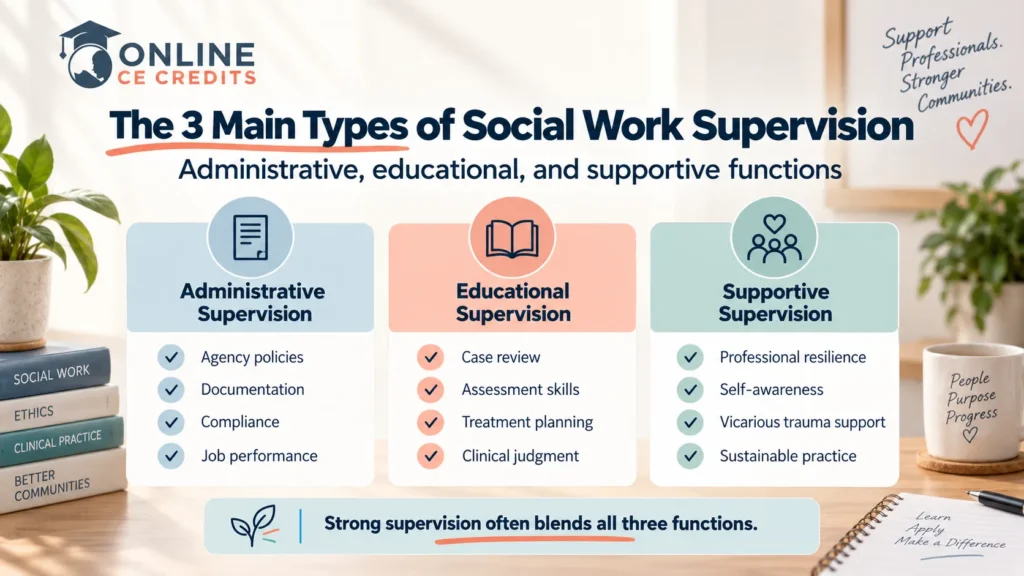
What Are the Three Main Types of Social Work Supervision?
The NASW and ASWB Best Practice Standards in Social Work Supervision describe three primary supervision functions: administrative, educational, and supportive supervision.
Administrative Supervision
Administrative supervision focuses on how a social worker performs within an organization.
This can include:
- Agency policies
- Caseload management
- Documentation
- Productivity
- Compliance
- Job performance
- Organizational procedures
The goal is to make sure services are delivered effectively and in accordance with agency expectations.
Educational Supervision
Educational supervision focuses on developing the supervisee’s professional knowledge and clinical skills.
This may involve:
- Reviewing cases
- Strengthening assessment skills
- Treatment planning
- Improving interventions
- Ethical problem-solving
- Applying theory to practice
- Developing clinical judgment
For clinicians working toward independent licensure, this is often one of the most visible parts of supervision.
Supportive Supervision
Social work can expose clinicians to heavy caseloads, complex client needs, crisis work, vicarious trauma, and emotionally demanding situations.
Supportive supervision creates space to identify how those pressures are affecting professional practice.
Its purpose is not therapy for the supervisee. Rather, it supports professional functioning, resilience, self-awareness, and the ability to continue practicing effectively.
Good clinical supervision often includes elements of all three functions rather than treating them as completely separate activities.
Can Social Workers Earn Supervision CEUs Online?
Often, yes—but your board determines which formats it accepts.

Online clinical supervision training may be available as:
- Self-paced recorded courses
- Live interactive webinars
- Virtual workshops
- Multi-session training programs
Self-paced courses can work well for social workers who need flexibility, while live programs may be useful when a board requires interactive training or when you want opportunities to ask questions.
Online CE Credits offers both on-demand CE courses and live CE webinars for mental health professionals.
Before registering, check whether your board distinguishes between home-study, asynchronous, synchronous, or live continuing education.
How Do You Choose the Right Social Work Supervision CEU Course?
Start with your licensing requirements, not the course title.

1. Check Your State Requirements
Determine whether you actually need supervision-specific continuing education and how many hours are required.
Use our state CE requirements pages as a starting point, then confirm current rules with your licensing board.
2. Verify the CE Provider
Check whether your board recognizes the provider or approval organization.
Online CE Credits, operating as Mind Works Professional Education, Inc., is an ASWB Approved Continuing Education (ACE) Provider #1974. Regulatory boards remain the final authority on whether individual courses meet a licensee’s requirements.
You can review our current CE approvals before enrolling.
3. Confirm the Credit Category
If you specifically need supervision CE, confirm that the course qualifies for that requirement.
Do not assume general ethics or clinical CE will automatically satisfy a supervision-specific mandate.
4. Check the Delivery Format
If your state requires live or interactive education, an asynchronous recorded course may not satisfy that portion of the requirement.
Likewise, if home-study CE is permitted, self-paced courses may be a much more convenient option.
5. Choose Training You Can Use
Meeting your renewal requirement matters, but good supervision CE should also improve the way you supervise.
Prioritize courses that address situations you actually encounter, such as:
- Ethical conflicts
- Remote supervision
- Difficult feedback
- Boundary concerns
- Documentation
- Supervisee competence
- Cultural differences
- Risk management
That gives you more value than simply selecting the shortest available course.
Social Work Supervision CEUs and Ethics
Ethics and supervision are closely connected.
Supervisors help shape how less-experienced clinicians understand professional responsibility, boundaries, documentation, client welfare, and scope of practice.
Ethical problems in supervision can include:
- Inadequate oversight
- Poor documentation
- Unclear roles
- Conflicts of interest
- Dual relationships
- Confidentiality issues
- Failure to address supervisee impairment
- Allowing practice outside the supervisee’s competence
- Problems with remote supervision
- Inadequate evaluation or feedback
For that reason, ethics-focused supervision training can be particularly useful for experienced clinicians taking on supervisory responsibilities.
Explore our ethics CEU courses or browse the complete online CE course library.
Frequently Asked Questions About Social Work Supervision CEUs
Are supervision CEUs required for LCSWs?
They may be required if you serve as a clinical supervisor, but requirements vary by jurisdiction. Some states require supervision-specific continuing education for approved supervisors, while others do not. Check your licensing board’s current requirements.
How many supervision CEUs does an LCSW need?
There is no nationwide requirement. The number of supervision CE hours depends on the state, type of license, supervisor designation, and renewal cycle.
Can I complete social work supervision CEUs online?
Many licensing boards permit online continuing education, but rules around asynchronous, home-study, and live interactive training vary. Confirm the accepted format with your state board before registering.
Does an ethics CE course count as supervision CE?
Not automatically. An ethics course may satisfy an ethics requirement without satisfying a separate supervision requirement. A course addressing ethics specifically within clinical supervision may qualify for both in some jurisdictions, but your board determines acceptance.
Do I need supervision training before supervising social workers?
Some jurisdictions require formal supervisor training or specific qualifications before a social worker can provide clinical supervision toward licensure. Others use different eligibility requirements. Review your state’s regulations before agreeing to provide supervision.
What topics should a clinical supervision course include?
Useful topics include supervision models, ethics, boundaries, competency assessment, documentation, feedback, cultural responsiveness, liability, telehealth supervision, and managing difficult supervisory situations.
Do supervision CEUs also count toward my regular social work CE requirements?
They may. Some jurisdictions allow supervision education to count toward the overall CE requirement while also satisfying a supervision-specific requirement. Others structure categories differently. Verify this with your licensing board.
Find Online CE Courses for Social Workers
If you need supervision training or are planning your next license renewal, start by identifying exactly what your state requires.
Online CE Credits provides continuing education for Licensed Clinical Social Workers, including clinical, ethics, cultural competence, and other professional training.
You can browse all online CE courses or check your state social work CE requirements before choosing your next course.
Always verify that the specific course, credit type, and delivery format meet the requirements of your licensing board.
by Tim Cassidy, MBA, MA, LPC | Aug 26, 2025 | Educational
Some clients feel better when they talk things through. Others feel stuck no matter what they say. In trauma work, talk alone is not always enough. That is where body-based and brain-based therapies come in, offering different ways to process pain, build safety, and regulate the nervous system.
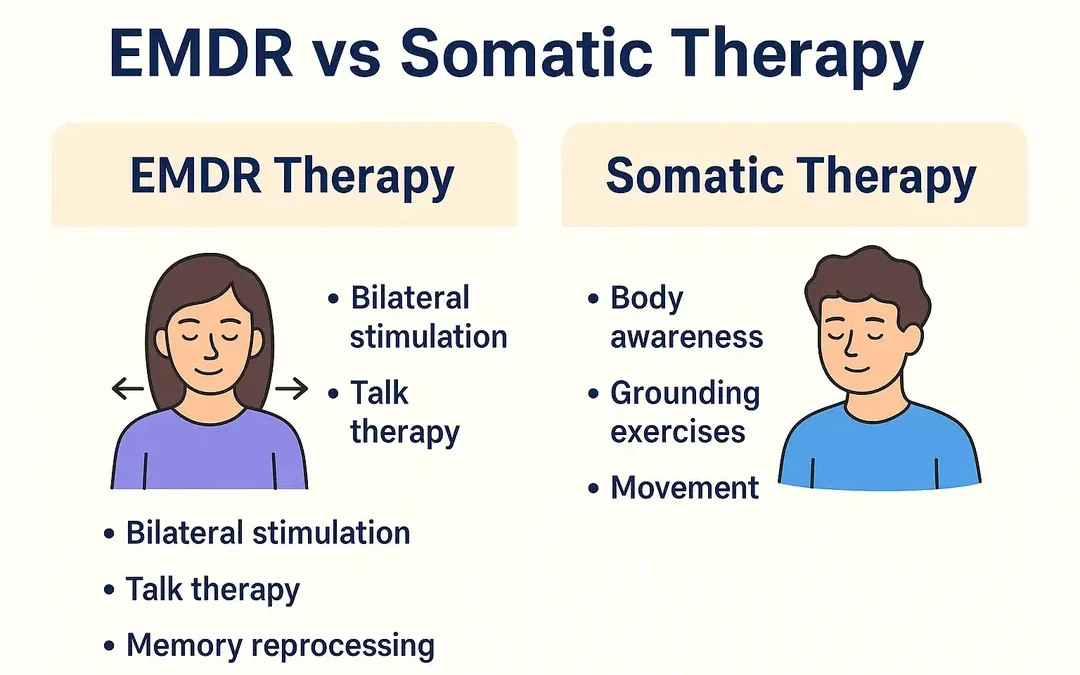
Two widely used trauma approaches are Eye Movement Desensitization and Reprocessing (EMDR) and Somatic Therapy. Both help reduce symptoms, but they take very different routes.
This guide breaks down EMDR vs. somatic therapy, how they work, what makes them different, and how clinicians can decide which fits best.
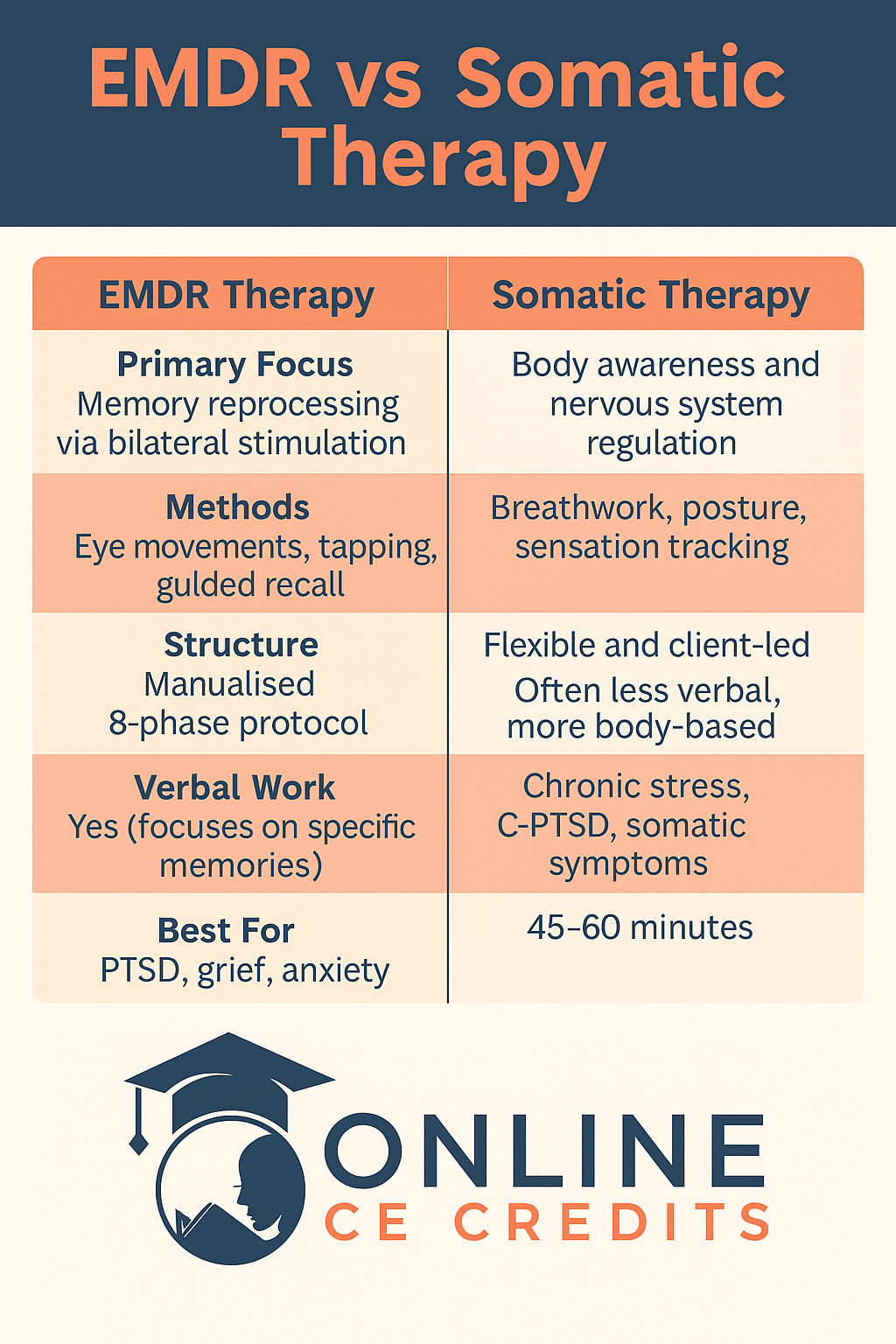
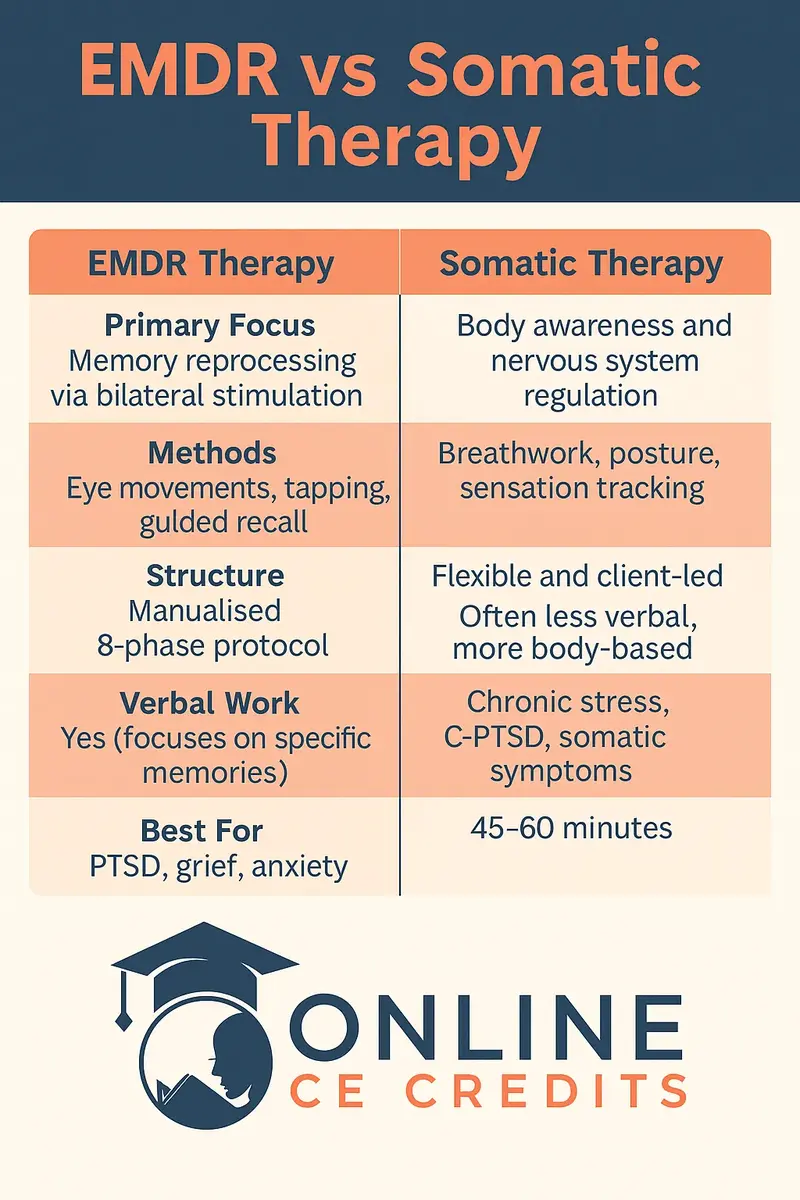
Quick Comparison Table – EMDR vs Somatic Therapy
Here is a side-by-side look at the key differences:
| Factor |
EMDR Therapy |
Somatic Therapy |
| Primary Focus |
Memory reprocessing via bilateral stimulation |
Body awareness and nervous system regulation |
| Methods |
Eye movements, tapping, guided recall |
Breathwork, posture, sensation tracking |
| Structure |
Manualised 8-phase protocol |
Flexible and client-led |
| Verbal Work |
Yes (focuses on specific memories) |
Often less verbal, more body-based |
| Best For |
PTSD, grief, anxiety |
Chronic stress, C-PTSD, somatic symptoms |
| Session Length |
60-90 minutes |
45-60 minutes |
★ Recommended Course for This Topic
Somatic-Based Interventions: A Body-Centered Approach for Healing Trauma
Approved
✓ Board Approved
Credits
5.0 CEUs
Format
Online + Instant Quiz
Price
$150
Get Credits Now →
Instant certificate · 100% online · Accepted by most state licensing boards
What Is EMDR Therapy?
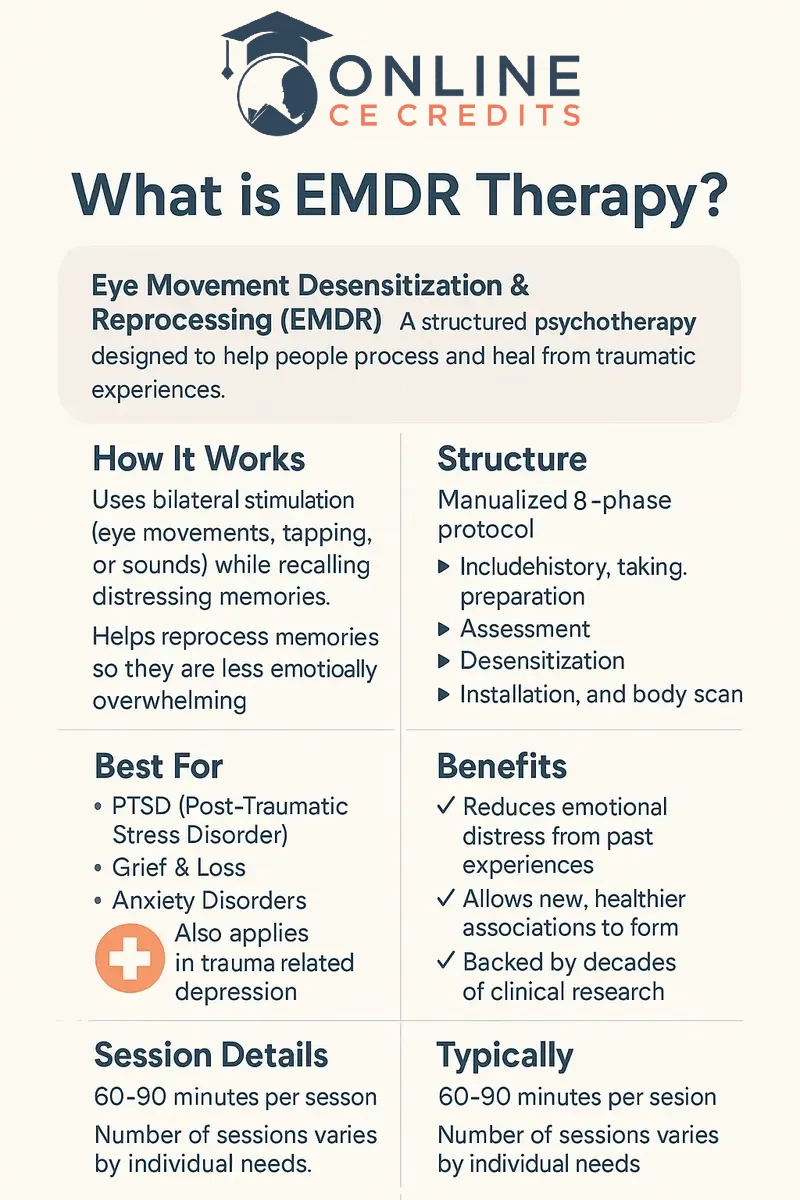
EMDR therapy was developed in the late 1980s by Dr. Francine Shapiro. It is best known for helping clients reprocess distressing memories through bilateral stimulation, typically eye movements, tapping, or alternating sounds.
During an EMDR session, the client recalls a traumatic memory while focusing on bilateral cues. This helps the brain integrate the memory in a more adaptive way, reducing its emotional intensity over time. The EMDR therapy follows an 8-phase protocol and does not require clients to describe the memory in detail.
EMDR is recommended by the World Health Organization, APA, and U.S. Department of Veterans Affairs as a first-line treatment for PTSD. It has also shown benefit for anxiety, grief, and phobias. For therapists looking to deepen their skills, EMDR courses and EMDR certification paths are available through Online CE Credits.
What Is Somatic Therapy?
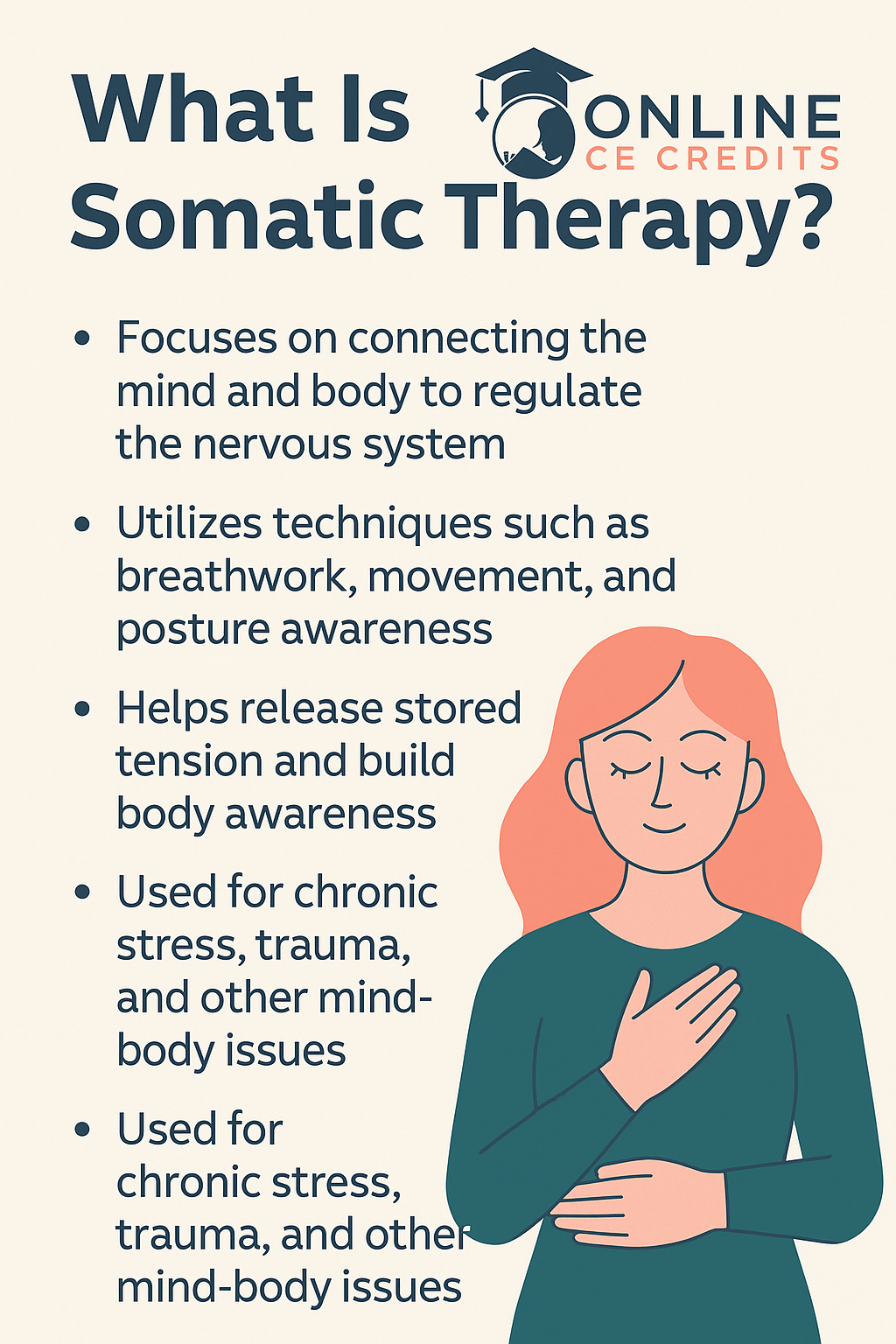
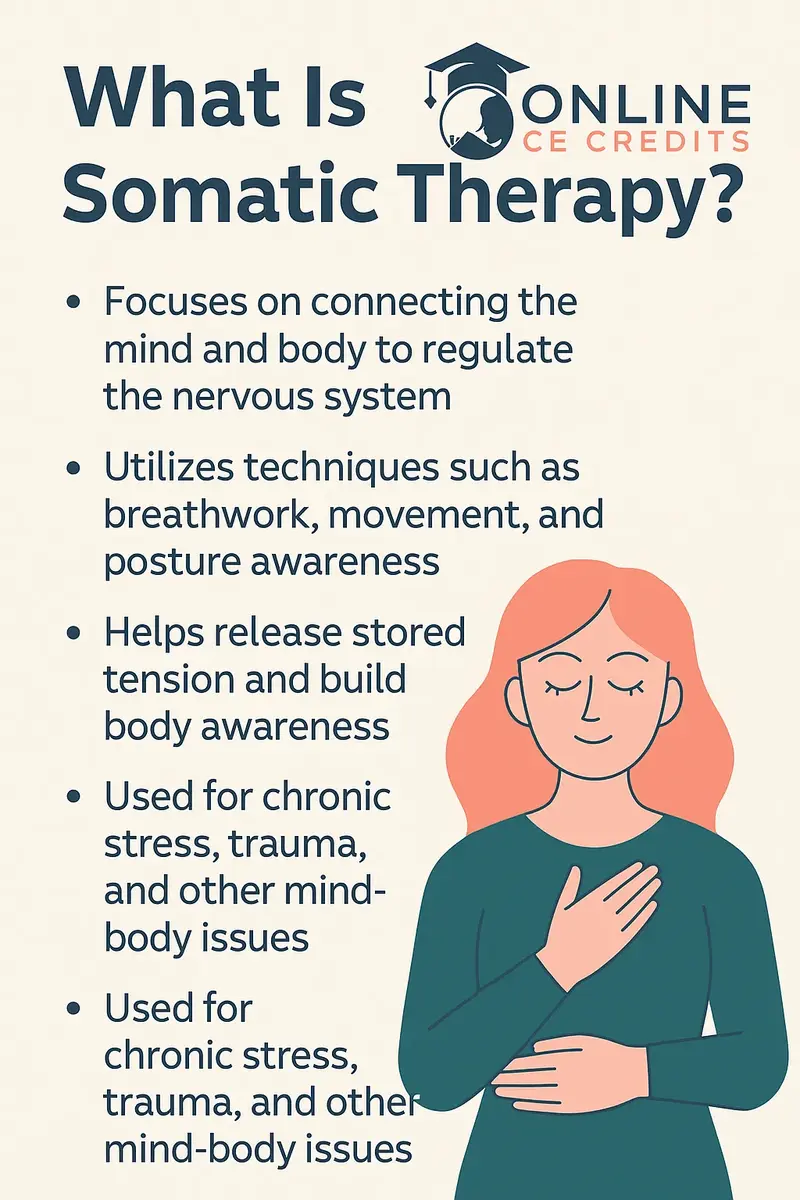
Somatic therapy is rooted in body-centered psychotherapy. It works by helping clients tune into physical sensations, breath, and postural shifts that may reflect unprocessed trauma. Unlike EMDR, somatic work focuses on the felt sense rather than the specific narrative.
Common techniques include breathwork, grounding exercises, movement, and sensation tracking. The goal is to help clients build awareness of how trauma lives in the body and to slowly release stored tension.
Approaches like Somatic Experiencing (developed by Dr. Peter Levine) and Sensorimotor Psychotherapy (pioneered by Dr. Pat Ogden) have become increasingly popular among trauma therapists. Somatic therapy can support clients who struggle with dissociation, hypervigilance, or emotional overwhelm.
For training options, Online CE Credits offers somatic therapy courses with CE approval.
EMDR vs Somatic Therapy – Key Differences
While both EMDR and somatic therapy are trauma-informed, their methods and goals are different.
Method & Focus
EMDR targets how traumatic memories are stored in the brain. It uses bilateral stimulation to promote memory reconsolidation. The client often works through specific events in a structured sequence.
Somatic therapy focuses on body awareness and nervous system regulation. It encourages clients to explore physical sensations without needing to retell or reframe specific memories. This makes it well-suited for clients with developmental trauma or limited verbal access.
Session Experience
EMDR sessions tend to be more structured. Clients move through distinct phases, from preparation to reprocessing and integration. The work is often active and focused, with attention on cognitive shifts.
Somatic sessions are typically slower and more fluid. The therapist might guide the client to notice areas of tension, shifts in breath, or subtle changes in posture. It can feel more experiential and less cognitively demanding.
Time to Results
EMDR often shows results within 8-12 sessions for single-incident trauma. Research has shown a reduction in PTSD symptoms after just a few weeks of treatment.
Somatic therapy may take longer to show measurable change, especially with complex trauma. However, its impact on nervous system regulation, sleep, and physical symptoms is often meaningful over time. The slower pace can be more sustainable for some clients.
Read more: Prolonged Exposure vs EMDR
How to Know Which Therapy Fits Your Client Best

There is no “wrong” choice. It all comes down to how trauma shows up in the body, mind, and daily life.
Somatic therapy may be the better fit for clients who:
- Experience chronic tension, pain, or numbness linked to trauma
- Feel disconnected from their emotions or bodily sensations
- Are drawn to a body-based approach that goes beyond words
- Have tried talk therapy and sensed something deeper was left unresolved
EMDR may be more appropriate for those who:
- Struggle with specific traumatic memories or flashbacks
- Experience intrusive thoughts, nightmares, or psychological distress
- Prefer a structured, goal-oriented approach
- Want to avoid going into detail about their traumatic experiences
In many cases, client preference, pacing needs, and clinical readiness can help guide the way. It is less about finding the “best” therapy and more about choosing the one that meets the client where they are.
Continue Your Learning
Recommended Courses
✓ Board Approved
Vagal Toning Masterclass: Tools for Nervous System Regulation and Client Wellness
5.75 CEUs · Online + Instant Quiz
✓ Board Approved
Polyvagal Self-Regulation for Clinicians: A Mastery Approach to Co-Regulation
2.5 CEUs · Online + Instant Quiz
Pros and Cons of Each
✅ Pros of EMDR:
- Backed by global health agencies for PTSD
- Often leads to faster symptom relief
- Follows a clear, structured protocol
- Adaptable to telehealth settings
- Can be combined with other approaches
⚠️ Cons of EMDR:
- Requires mental focus and memory recall
- May not suit clients with high dissociation
- Sessions can be emotionally intense
✅ Pros of Somatic Therapy:
- Ideal for clients disconnected from emotions or body
- Supports nervous system regulation and trauma release
- Often less cognitively demanding
- Accessible for nonverbal or body-aware clients
⚠️ Cons of Somatic Therapy:
- Research base is smaller compared to EMDR
- Progress may be slower or less linear
- Requires careful pacing with complex trauma
Can EMDR and Somatic Therapy Be Combined?

Yes, and many clinicians find they complement each other well. For example, somatic techniques can be used to ground clients before or after EMDR sessions. Clients with complex trauma may benefit from starting with somatic work to build tolerance before engaging in memory reprocessing.
An integrated approach helps therapists stay flexible and trauma-responsive. Many advanced EMDR practitioners incorporate somatic tools into their work. For those ready to deepen their training, Online CE Credits offers an Advanced EMDR Certification that includes these integrative methods.
FAQ
Is EMDR Therapy More Effective Than Somatic Therapy?
EMDR has a larger evidence base, especially for PTSD. Somatic therapy has growing support for emotional regulation and chronic trauma. The best choice depends on the client’s needs.
Can You Do EMDR and Somatic Therapy at the Same Time?
Yes. Many therapists use somatic grounding techniques alongside EMDR to improve safety, pacing, and integration.
Does EMDR Lead to Somatic De-Arousal?
Yes. EMDR often reduces physiological arousal by reprocessing stored stress. Clients may notice relaxed breathing or reduced body tension after sessions.
Can You Do Somatic Therapy Online?
Yes, though it may require adjustments. Many somatic tools, like breathwork and interoception, can be guided virtually with proper training.
How Many Sessions Does EMDR Take?
For single-event trauma, EMDR can take 8-12 sessions. Complex trauma may require more time.
Which Therapy Is Better for Complex PTSD?
Somatic therapy is often a safer starting point for complex trauma. EMDR can be introduced once regulation improves.
by Tim Cassidy, MBA, MA, LPC | Jul 7, 2025 | Educational
Most therapists learn about EMDR in bits and pieces, maybe during grad school or through a colleague’s quick explanation. But when it comes time to actually use it with clients, that patchy knowledge can leave you second-guessing yourself.
EMDR isn’t just a technique, it’s a full treatment framework. And the eight phases aren’t just boxes to check off. They’re practical steps designed to keep therapy safe, focused, and grounded in the present moment. For many clients, this structure is what allows them to finally process what felt impossible for years.
8 Phases of EMDR Therapy
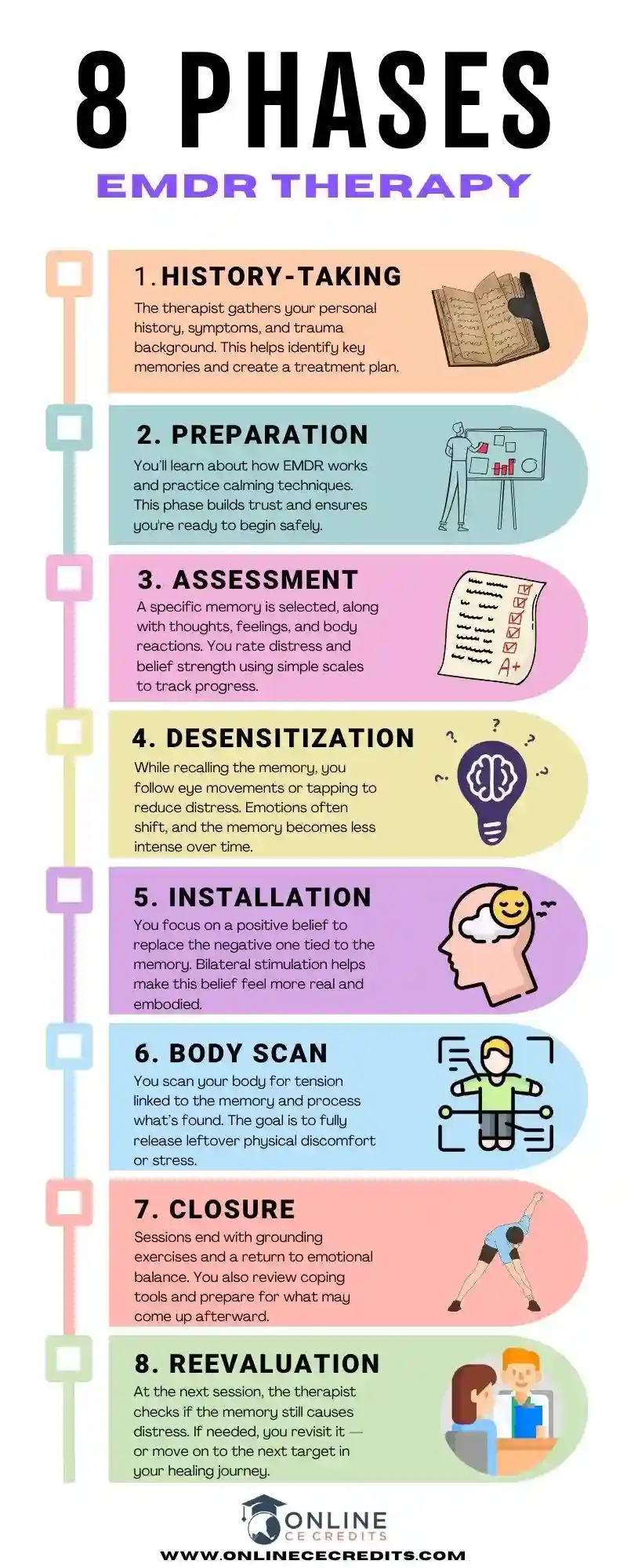
The eight phases of EMDR therapy give structure to trauma treatment. They help the therapist understand where the client is in the healing process and ensure that therapy progresses safely and effectively.
★ Recommended Course for This Topic
EMDR Comprehensive Foundations for Trauma Treatment
Approved
✓ Board Approved
Credits
23 CEUs
Format
Online + Instant Quiz
Price
$690
Get Credits Now →
Instant certificate · 100% online · Accepted by most state licensing boards
Each phase has a purpose, from getting to know your client’s history to supporting them in reducing distress tied to past events.
Here’s how it works.
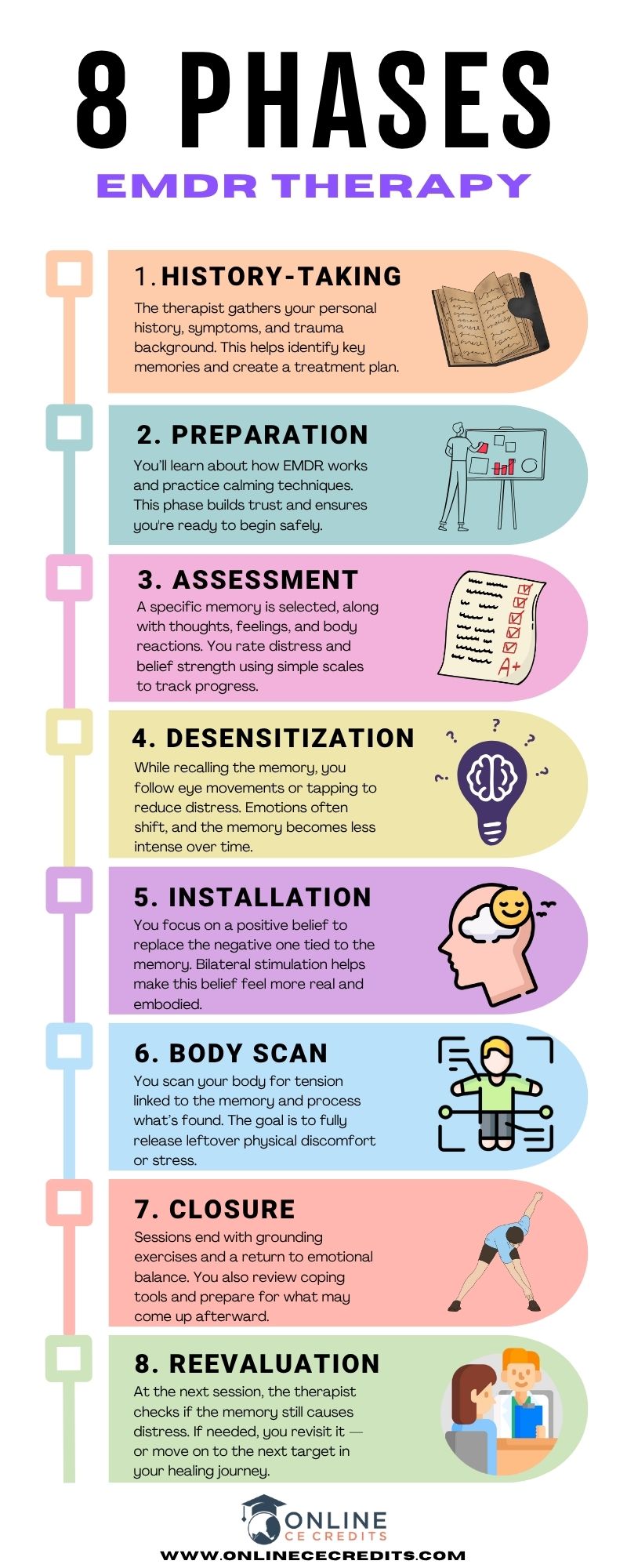
Phase 1: History-Taking & Treatment Planning

This phase is all about getting the full picture. The therapist gathers a detailed history to understand what the client has been through and what symptoms are showing up today.
The therapist also identifies possible target memories for reprocessing. These might include traumatic events, specific triggers, or recurring beliefs that keep the client stuck. This is where the work begins, and the treatment plan starts to take shape.
Target selection can look different in specialized applications. In the DeTUR EMDR protocol, for example, treatment commonly begins with present triggers and urge states associated with addictive or dysfunctional behaviors.
Phase 2: Preparation
Now it’s time to build trust and make sure the client feels ready. In this phase, the therapist explains how EMDR works and introduces calming strategies the client can use throughout the process.
Clients might practice breathing exercises or create a mental “safe place” they can return to if they feel overwhelmed. The goal is to ensure the client can stay inside their window of tolerance as they begin to explore difficult material.
Phase 3: Assessment
In the assessment phase, the therapist and client choose one specific memory to focus on. Together, they identify:
- A clear image that represents the memory
- A negative belief tied to it
- A positive belief the client would rather believe
- Emotions and body sensations that come up when recalling the memory
The client then rates the memory using two simple tools: the SUDS scale (to rate distress) and the VOC scale (to rate how believable the positive belief feels). These tools help measure change over time.
Phase 4: Desensitization (Most Recognizable Phase)

This is the phase many people associate with EMDR. While focusing on the target memory, the client follows the therapist’s hand with their eyes or uses another form of bilateral stimulation, like tapping or tones.
The memory starts to shift. Clients often report new insights or emotions. Sometimes, the original image loses its emotional charge. The therapist guides the process gently, helping the client stay grounded and present.
Continue Your Learning
Recommended Courses
✓ Board Approved
Advanced EMDR Skills for Complex Trauma
8.75 CEUs · Online + Instant Quiz
✓ Board Approved
Must-Have EMDR Skills for Online Therapy and Telehealth
1.75 CEUs · Online + Instant Quiz
Phase 5: Installation
Once the distress has gone down, the therapist helps the client focus on the positive belief they chose earlier, something like “I am safe now” or “It wasn’t my fault.”
Through more bilateral stimulation, this belief is strengthened. It becomes more than just a thought, it starts to feel real.
Phase 6: Body Scan

Even if the distress feels lower, trauma can still leave a mark on the body. During the body scan, the therapist asks the client to notice any remaining tension, discomfort, or sensations related to the memory.
If anything comes up, the therapist helps the client process it using the same EMDR techniques until the body feels calm.
Read more: EMDR vs Talk Therapy
Phase 7: Closure
Each session ends with closure, even if the memory wasn’t fully processed. The therapist helps the client return to the present moment using grounding techniques.
This phase also includes reviewing coping tools, encouraging journaling, or talking through what to expect between sessions. It’s a chance to check in and support the client’s emotional safety.
Phase 8: Reevaluation
At the start of the next session, the therapist and client revisit the previous memory to see how it feels now.
If the client still feels distressed, the therapist may return to earlier phases. If not, they may move on to another target. This phase helps track long-term progress and adjust the treatment plan as needed.
Read more: compare EMDR with Prolonged Exposure therapy
8 Phases of EMDR Therapy (INFOGRAPHIC)
Why Choose Online CE Credits EMDR Courses?
At Online CE Credits, EMDR training is grounded in real clinical practice, not just theory. We offer two practical certification programs designed to help licensed mental health professionals build EMDR skills confidently and affordably.
Our EMDR courses include:
- Structured training in all 8 phases of EMDR therapy
- Lifetime access to materials so you can review any time
- Four hours of included consultation to help apply what you learn
- No ongoing fees or “renewals” required
We believe that clinicians should feel equipped to use EMDR without jumping through expensive or confusing hoops. Our programs are independent, flexible, and built for working professionals.
Looking to deepen your skills in trauma treatment?
Explore our Foundational EMDR Therapy Certificate (EMDRPT-I) and Advanced EMDR Therapy Certificate (EMDRPT-II) programs today—and start building confidence with the 8 phases of EMDR in your own clinical work.
Read more: Is EMDR Worth It?
FAQ
Why Is There a Controversy With EMDR?
Some debate around EMDR stems from its use of bilateral stimulation, which is different from other therapies. While the exact mechanism is still being studied, decades of research have shown EMDR can lead to significant symptom reduction in clients with PTSD and trauma histories.
What Not To Do After EMDR?
After EMDR, clients should avoid high-stress situations when possible. Some clients feel emotionally tired or experience vivid dreams. Encourage clients to practice grounding techniques and get rest.
Do Patients Cry During EMDR?
Yes, it’s common. EMDR often brings up strong emotions. Crying is a natural part of releasing trauma and doesn’t mean something has gone wrong, it can actually signal movement and healing.
How Does EMDR Rewire the Brain?
EMDR may support changes in how the brain stores and processes traumatic memories. As clients reprocess memories while staying present, those memories can shift from being emotionally charged to feeling more distant and neutral.
by Jennifer Sweeton, PsyD, JD, MS, MA | Oct 1, 2025 | Educational
Most clinicians working with trauma have heard the same questions: How long does EMDR take to work? When will I feel better? Is it going to be months or years?
These are fair questions. When someone carries traumatic memories that have shaped their sense of self, time matters. So does relief.
Eye Movement Desensitization and Reprocessing (EMDR) is a structured, evidence-based therapy designed to help people process traumatic memories without needing to relive every detail. But while EMDR can create meaningful change quickly, timelines vary. The path looks different for single-event trauma versus complex trauma, and many factors influence the pace.
Here, you will learn what clinicians and clients can expect from the EMDR therapy process, session counts, progress timelines, and what affects the speed of results.
For an overview of the treatment flow, see our guide to the 8 phases of EMDR.
Quick Answer – How Long Does EMDR Take to Work?
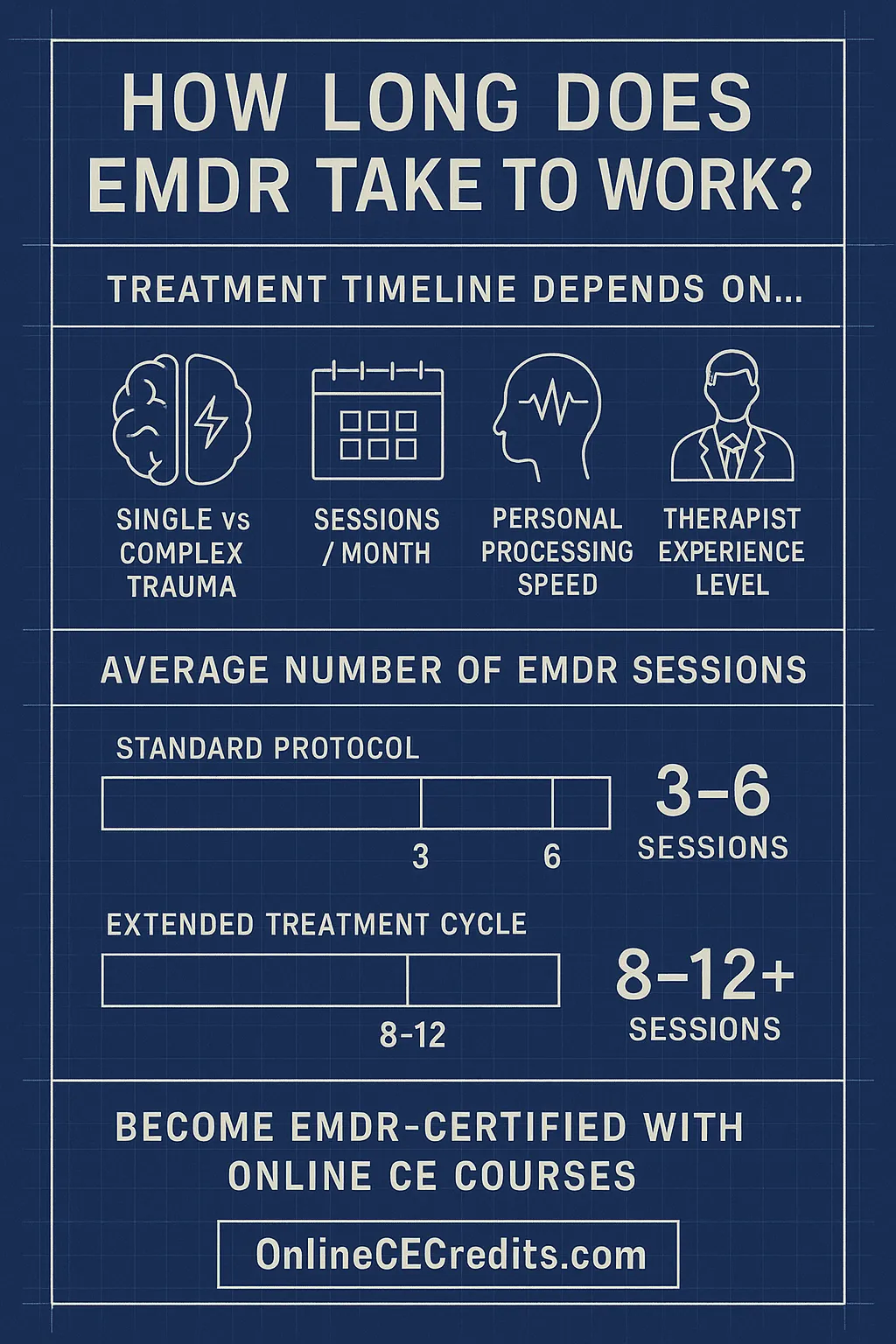
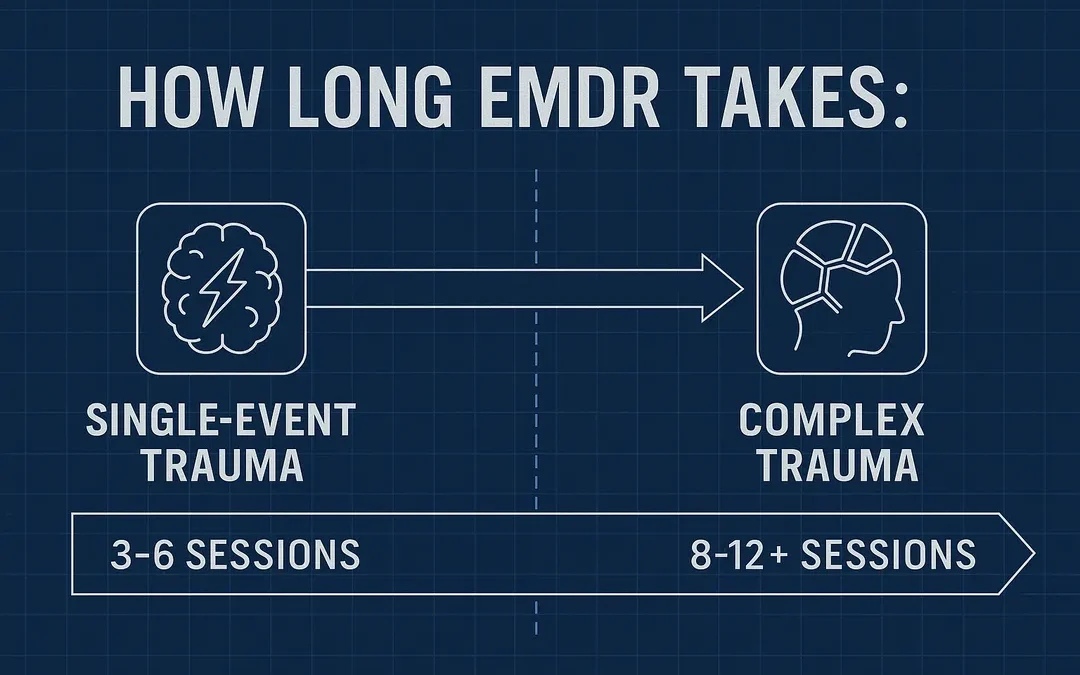
Most clients with single-event trauma notice improvement within 3 to 6 EMDR sessions. For those with complex trauma, it often takes 8 to 12+ sessions, sometimes over the course of months.
Sessions typically run 60 to 90 minutes, once or twice a week. Some clients feel emotional shifts after just a few sessions. Others may need a longer foundation of stabilization before the desensitization phase begins.
Progress is rarely linear. It builds in waves, and sometimes, one breakthrough can change everything. Even in early sessions, many clients experience cognitive and emotional shifts that reflect what Shapiro called “accelerated information processing” in the EMDR framework.
EMDR Timeline at a Glance
Here’s a side-by-side look at typical scenarios and how long EMDR therapy may take:
| Scenario |
Prep (Phases 1-2) |
Processing (Phases 3-7) |
Cadence |
Typical Total |
Notes |
| Single-event adult PTSD |
1-3 sessions |
3-6 sessions |
Weekly, 60-90 min |
4-10 sessions over 1-2 months |
Per target, often 1-3 sessions; early shifts common (Cleveland Clinic, EMDRIA) |
| Complex trauma / C-PTSD |
3-8+ sessions |
8-12+ sessions |
Weekly or 2×/week |
Several months |
Depends on trauma load, dissociation, and nervous system stability (PTSD VA) |
| Ongoing stressors / co-occurring conditions |
Extended prep |
Variable (12+) |
Weekly or 2×/week |
Months |
Treat medical/sleep issues to support progress |
| Children and teens |
Brief-moderate |
Up to 12 (target-based) |
Shorter, age-appropriate sessions |
Weeks-months |
Family involvement and developmentally adapted protocols |
| Phobias / discrete targets |
Minimal |
1-3+ per target |
Weekly, 60-90 min |
Few weeks |
Often resolves faster with a clear memory or event |
| Non-PTSD use (e.g., anxiety, depression) |
Variable |
Variable |
Weekly or intensives |
Varies |
Evidence growing; case-by-case timelines (PMC) |
Many PTSD protocols are weekly, up to 90 minutes, over ~3 months; shorter or longer courses are possible. Intensives/twice-weekly formats may accelerate progress when suitable.
Read more: EMDR vs Prolonged Exposure
What “Work” Means in EMDR

When clients or clinicians ask how long EMDR takes to work, they are often referring to noticeable relief, not just symptom resolution. In clinical terms, EMDR is “working” when emotional intensity tied to distressing memories begins to reduce, and adaptive functioning increases.
Signs may include:
- Lower SUDS (Subjective Units of Disturbance) ratings between or within sessions
- Fewer trauma triggers, nightmares, or flashbacks
- Improved sleep, concentration, or relational boundaries
- Shifts from negative beliefs (e.g., “I am helpless”) to positive beliefs (e.g., “I can cope”)
Studies show many clients experience some level of relief within the first 3-4 EMDR sessions.
Full post traumatic stress disorder remission may take longer, but early functional gains are often clear.
What Affects How Fast EMDR Works
The speed of EMDR depends on the story behind the symptoms. No two timelines look the same.
Trauma Profile & Load
The nature of trauma matters. A single car accident, for example, usually processes faster than chronic childhood abuse.
Clients with multiple or developmental traumas may have dozens of memory “targets,” each needing attention. Dissociation, age at trauma, and current safety all shape the pace of EMDR therapy.
Preparation & Stabilization
Phases 1 and 2 of EMDR involve treatment planning, gathering history, and building internal resources. In complex cases, this preparation may take weeks, but skipping it risks flooding, shutdown, or premature dropout.
According to a study published in Frontiers in Technology, effective resourcing protects clients and often leads to smoother, more efficient processing later on.
Session Length & Frequency

Most EMDR sessions last 60 to 90 minutes. Weekly pacing is common, though twice-weekly sessions or intensive EMDR formats (half-day or multi-day blocks) may speed results for appropriate clients.
That said, faster is not always better. Some nervous systems benefit from a slower pace with time to integrate between sessions.
Co-Occurring Conditions & Lifestyle Factors
Sleep disturbances, depression, substance use, and high stress can slow EMDR’s progress. Addressing these factors, either through coordinated care or brief pauses, can improve therapy outcomes.
For instance, a client actively navigating a toxic home environment may need safety planning before trauma processing begins.
Therapist Expertise & Protocol Fidelity
A well-trained EMDR therapist who follows protocol, especially with complex trauma, can make a noticeable difference. Familiarity with adaptations, dissociation flags, and pacing needs improves both safety and results.
The 8 Phases – Super Brief Overview
The full EMDR therapy process unfolds over eight phases, from history-taking to reevaluation. Each step matters, but not every client will move through them at the same speed.
- History-Taking
- Preparation
- Assessment
- Desensitization
- Installation
- Body Scan
- Closure
- Reevaluation
For a detailed guide, visit our 8 Phases of EMDR Therapy.
Signs EMDR Is Working

Progress in EMDR therapy does not always feel linear, but it is often measurable. Relief may come in quiet, functional shifts before major breakthroughs happen.
Many clients begin to notice changes after just a few sessions, even if full resolution takes longer.
Here are common early signs that the EMDR therapy process is helping:
- Emotional triggers that once felt overwhelming now feel blunted or easier to manage
- Nightmares or flashbacks become less frequent or lose their emotional intensity
- Physical tension (jaw, shoulders, stomach) decreases during or after sessions
- Strong emotions surface, but clients stay present, rather than dissociating or shutting down
- Startle responses ease; daily routines feel less effortful or guarded
- Clients begin to describe themselves with more self-compassion or agency
- The original memory still exists, but no longer hijacks their day
For deeper insight, here are paraphrased reflections from clients who have shared their EMDR timelines anonymously on Reddit:
“I was in EMDR for C-PTSD. It took about 20 months, weekly. After reprocessing my earliest trauma, I finally felt like I could get through the rest. Each new memory was its own mountain, but every session helped me feel lighter.”
“After my very first session, something shifted. But I have layers of trauma. Some sessions were devastating, others gave me peace. The process feels more like learning to live fully than ‘getting fixed.’”
“I have had around eight EMDR sessions so far. I still get flooded sometimes and need breaks, but I know we are moving forward. My system holds a lot, and that is okay. My therapist goes slow, and it is working.”
These lived experiences reflect what many clinicians already know: healing from complex trauma is rarely fast, but the signs of growth are real, and they often begin quietly.
When Progress Stalls
Sometimes clients plateau or regress mid-process. Here is what clinicians can do:
- Revisit grounding skills and resourcing
- Reassess targets, some may be too large or layered
- Slow the cadence or break memories into smaller parts
- Address medical or sleep needs first
- Consider adjunct supports or consult on dissociation
Progress in EMDR is flexible. Stalling does not mean failure. It usually means something important is asking for attention.
How Long Do Results Last?
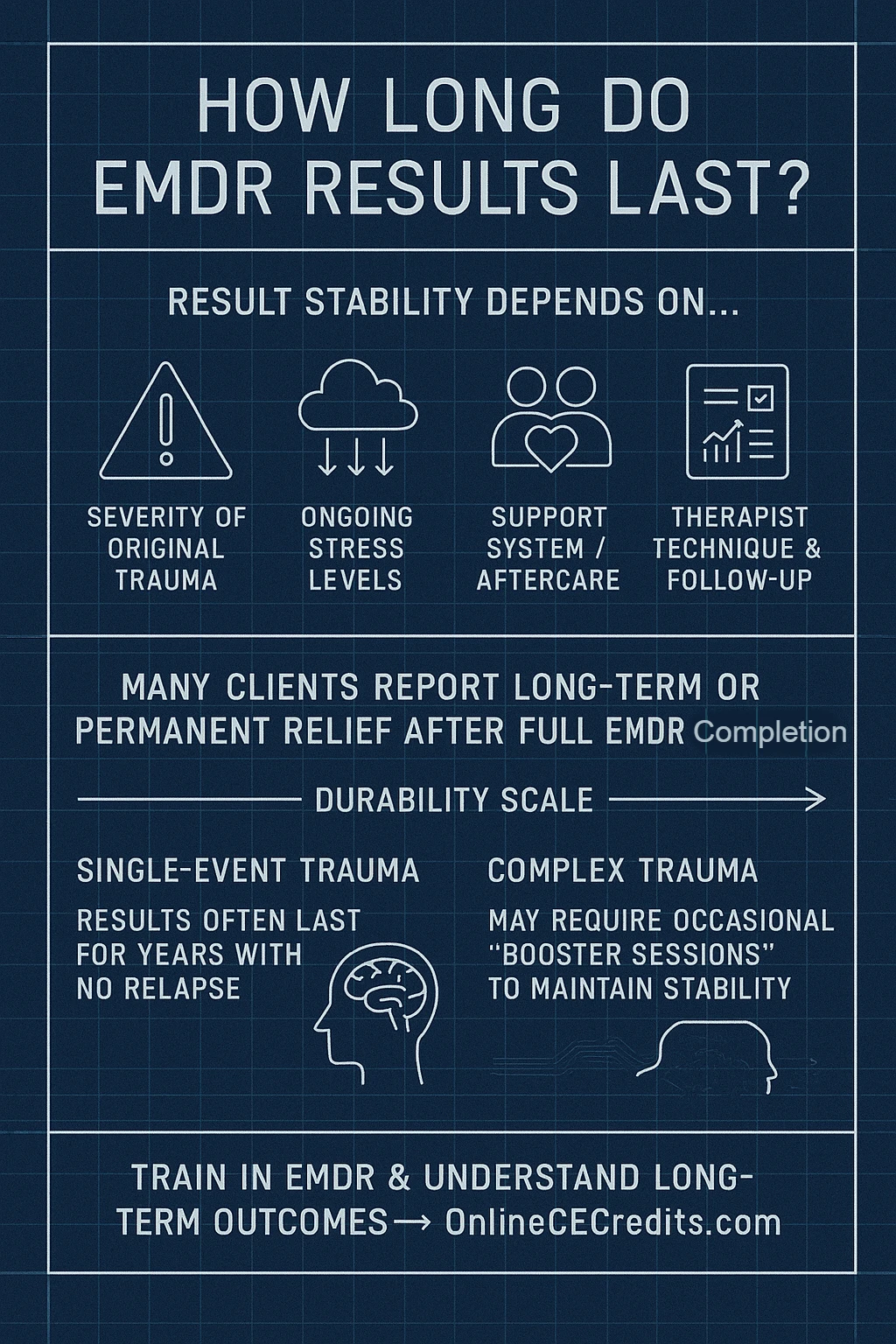
When EMDR works, results can be long-lasting. Clients often report durable symptom relief and new coping capacity.
But life changes, new stressors, or trauma anniversaries may trigger old material.
Occasional booster sessions or check-ins can support long-term resilience.
Cost, Access & Finding a Provider
EMDR session costs vary, but for many clients, a full course runs from $700 to $2,400+, depending on geography, session count, and format. Insurance coverage also varies.
Clients should look for clinicians who are EMDR-trained or certified. To learn what those credentials mean, see our guide on EMDR-trained vs. certified therapists.
Many therapists now offer EMDR intensives or telehealth EMDR, broadening access for busy professionals or rural clients.
For EMDR Practitioners: CE You Can Use on Monday
For licensed therapists offering EMDR or ready to get trained, Online CE Credits offers flexible, accredited education that fits your schedule.
✅ Certificate in EMDR Therapy Skills
✅ Certificate in Advanced EMDR Therapy Skills
✅ Full EMDR course library
Every course is written by clinicians, for clinicians. Earn CE hours while learning real tools you can use right away.
FAQs
Can EMDR be done online or as an intensive?
Yes. Many therapists offer EMDR via telehealth or in intensive formats. Research supports both when adapted properly, though fit depends on client needs, stability, and trauma history.
How many sessions per memory?
Typically, one memory takes 1-3 sessions to process fully. However, memories linked to early trauma or deep core beliefs may take longer due to emotional layering or dissociation.
How many EMDR sessions are needed for a single trauma?
For a single-event trauma, most clients need between 3-6 processing sessions. Including preparation and closure, the full course often spans 4-10 sessions total.
How many sessions for complex trauma/C-PTSD?
Clients with complex trauma often need 8-20+ sessions. This includes time for stabilization, processing multiple targets, and integration. Timelines vary based on history, pace, and nervous system readiness.
How long are EMDR sessions, and how often should I go?
Sessions usually last 60-90 minutes and occur weekly or twice weekly. Frequency depends on treatment goals, emotional readiness, and therapist availability.
Can EMDR work after one session?
Some clients report noticeable shifts after just one session. However, lasting change often builds gradually through repeated sessions and full processing of core memories.
What if I feel worse after EMDR?
It is common to feel unsettled after sessions. Emotional material may surface between visits. Grounding, self-care, and therapist support help manage these normal, temporary reactions.
Can I combine EMDR with CBT or somatic work?
Yes, many therapists blend EMDR with CBT techniques or somatic practices. It depends on the client’s goals and what helps them stay present, regulated, and supported.
How do I know EMDR is working?
You might notice fewer triggers, better sleep, or less emotional reactivity. Small shifts in beliefs or behaviour usually show up before bigger breakthroughs happen.

by Tim Cassidy, MBA, MA, LPC | Jan 10, 2020 | Educational
Ask ten licensed professionals how many CEUs they need, and you might get ten different answers. That’s because terms like “CEs,” “CEUs,” and “contact hours” are often used interchangeably. But they don’t always mean the same thing.
If you’re a therapist, social worker, nurse, or mental health professional, this guide clears up what each one actually means, how licensing boards define them, and how to make sure your continuing education credits count where it matters.
Quick Answer – What’s the Difference Between CEs, CEUs, and Contact Hours?
In simple terms:
- CEUs (Continuing Education Units) are a formal measurement system.
- CEs (Continuing Education Credits) refer more generally to educational hours.
- Contact Hours are time-based: one hour of learning equals one credit.
Continue Your Learning
Recommended Courses
✓ Board Approved
EMDR Comprehensive Foundations for Trauma Treatment
23 CEUs · Online + Instant Quiz
✓ Board Approved
"Felt Sense" Polyvagal Model: Re-envisioning Trauma & Addiction Treatment
2.5 CEUs · Online + Instant Quiz
Still, these terms overlap depending on your profession and state.
| Aspect |
Continuing Education Units (CEUs) |
Continuing Education (CEs) |
|
Contact Hours |
| Definition |
Standardized unit to quantify participation |
General term for professional learning |
|
Time-based measurement of instruction |
| Measurement |
1 CEU = 10 contact hours |
Often: 1 CE = 1 hour = 0.1 CEU |
|
1 hour = 1 contact hour |
| Purpose |
Tracks formal, structured education |
Supports clinical skill growth and license renewal |
|
Used for hourly credit tracking |
| Common Use |
Healthcare, nursing, corporate training |
Counseling, social work, psychology, massage therapy |
|
Nursing, education, behavioral health |
| Examples |
University-sponsored CEU certificate |
3-hour ethics workshop from a CE-approved provider |
|
Webinar with certificate for 2 contact hours |
| Accepted by Boards |
Depends on field and licensing body |
Accepted across many mental health professions |
|
Widely accepted, but still board-dependent |
| Accrediting Bodies |
ANSI/IACET |
NBCC, APA, ASWB, state boards |
|
Varies by field |
Read more: Live vs on-demand CEUS
What Are CEUs (Continuing Education Units)?
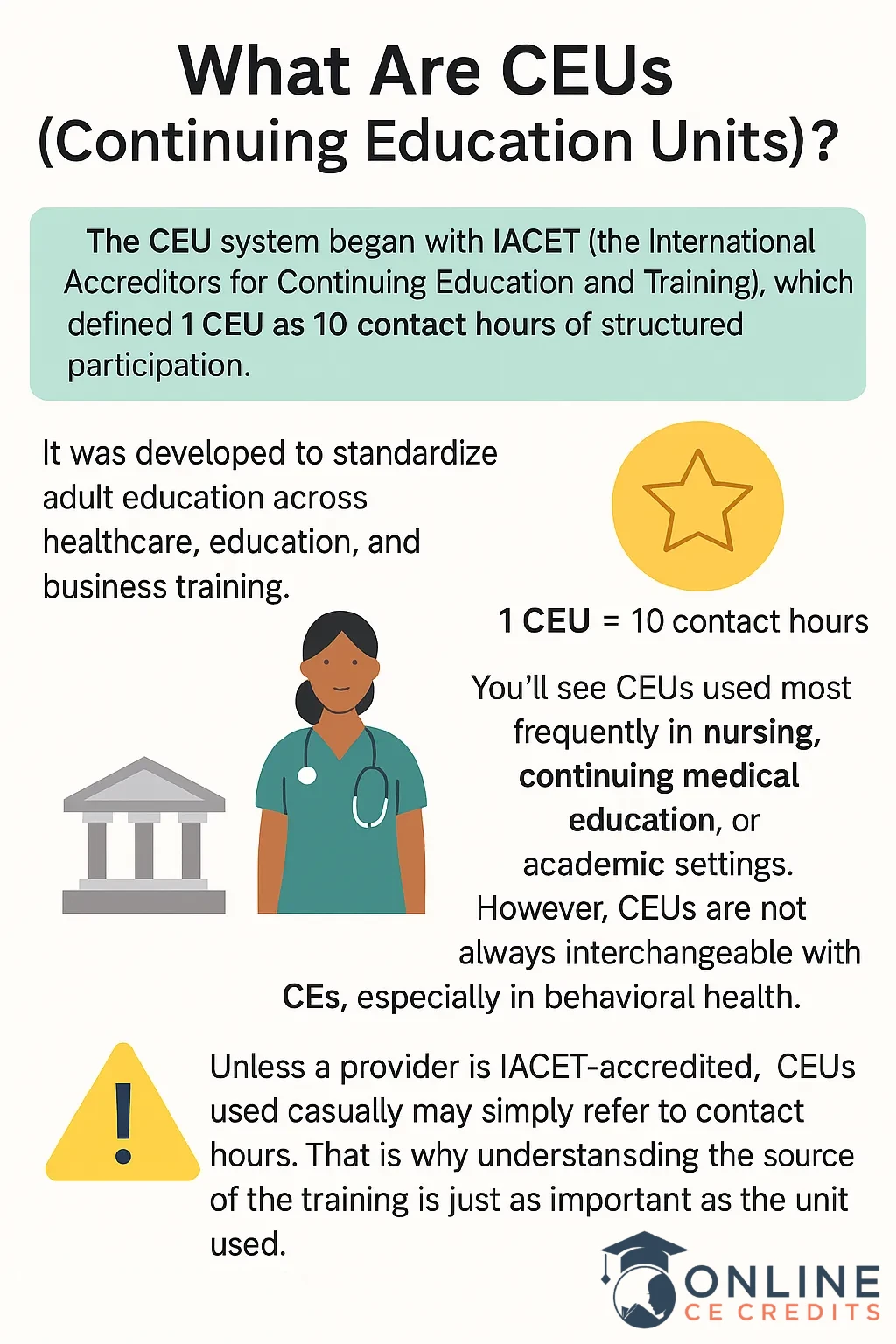
The CEU system began with IACET (the International Accreditors for Continuing Education and Training), which defined 1 CEU as 10 contact hours of structured participation. It was developed to standardize adult education across healthcare, education, and business training.
You’ll see CEUs used most frequently in nursing, continuing medical education, or academic settings. However, CEUs are not always interchangeable with CEs, especially in behavioral health.
Unless a provider is IACET-accredited, CEUs used casually may simply refer to contact hours. That is why understanding the source of the training is just as important as the unit used.
What Are CEs (Continuing Education Credits)?

“CEs” is the most common term in mental health professions. Most state licensing boards (including NBCC, ASWB, APA, and NAADAC affiliates) approve continuing education using contact hours as the unit, and refer to them as “CE credits” or simply “CEs.”
Here’s how they typically work:
- 1 hour of approved content = 1 CE credit
- Providers must hold board-approved status
- Professionals must submit certificates showing hours earned
At Online CE Credits, licensed professionals can earn CEs online, through live CE webinars, or via self-paced learning. Each activity clearly states credit hours and board approvals, removing the guesswork.
What Are Contact Hours?
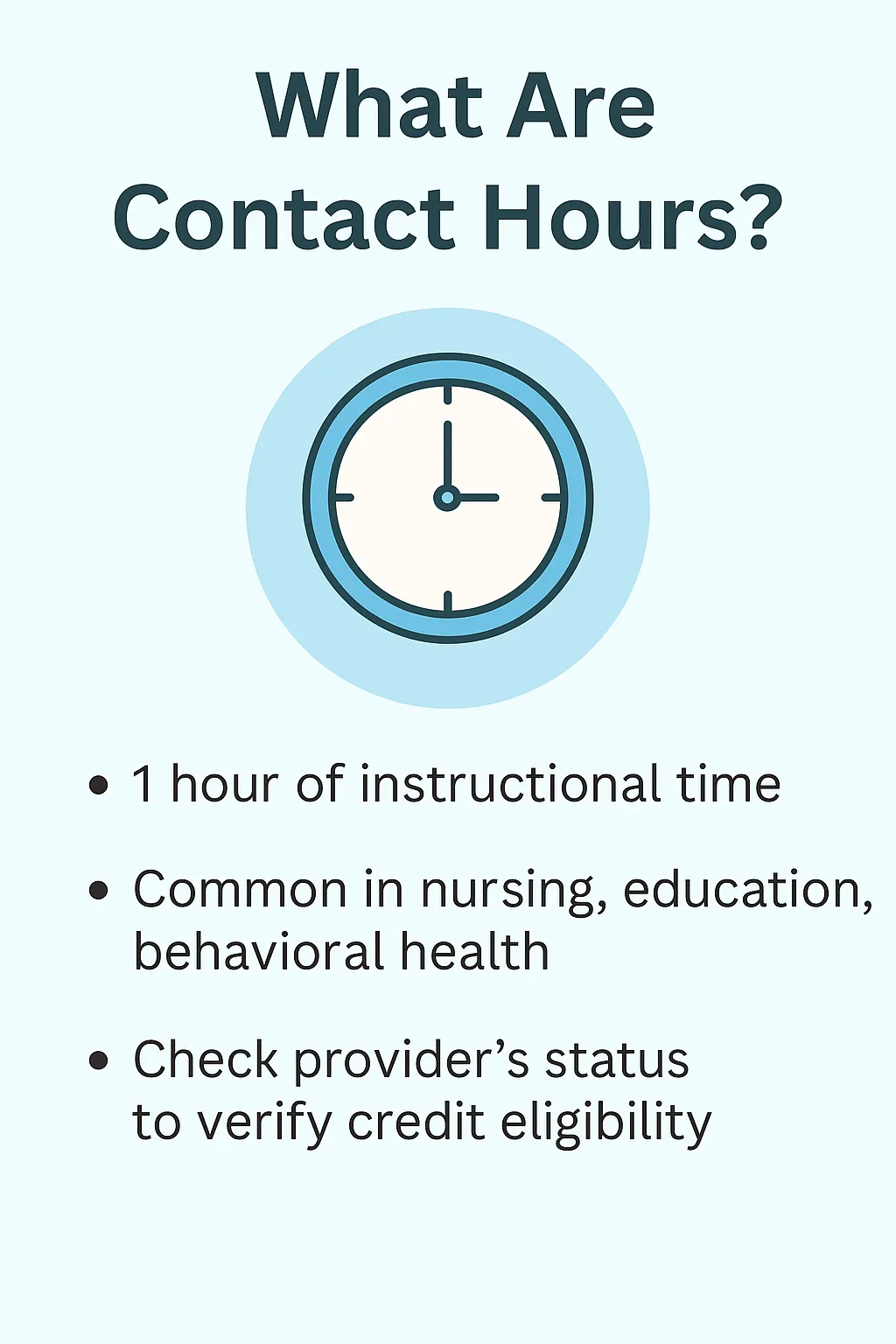
Contact hours are exactly what they sound like: one hour of instructional time equals one contact hour. This format is especially common in:
- Nursing
- Education
- Social work
- Substance use counseling
While contact hours and CEs often match 1:1, not all states treat them the same. Some boards require that contact hours come from an approved provider. Others use them synonymously with CEs. Still others convert them into CEUs using a 10:1 ratio.
If your board lists requirements in contact hours, be sure to verify how they define credit and whether the provider lists the same format on your certificate.
CE vs CEU vs Contact Hour – Are They Interchangeable?
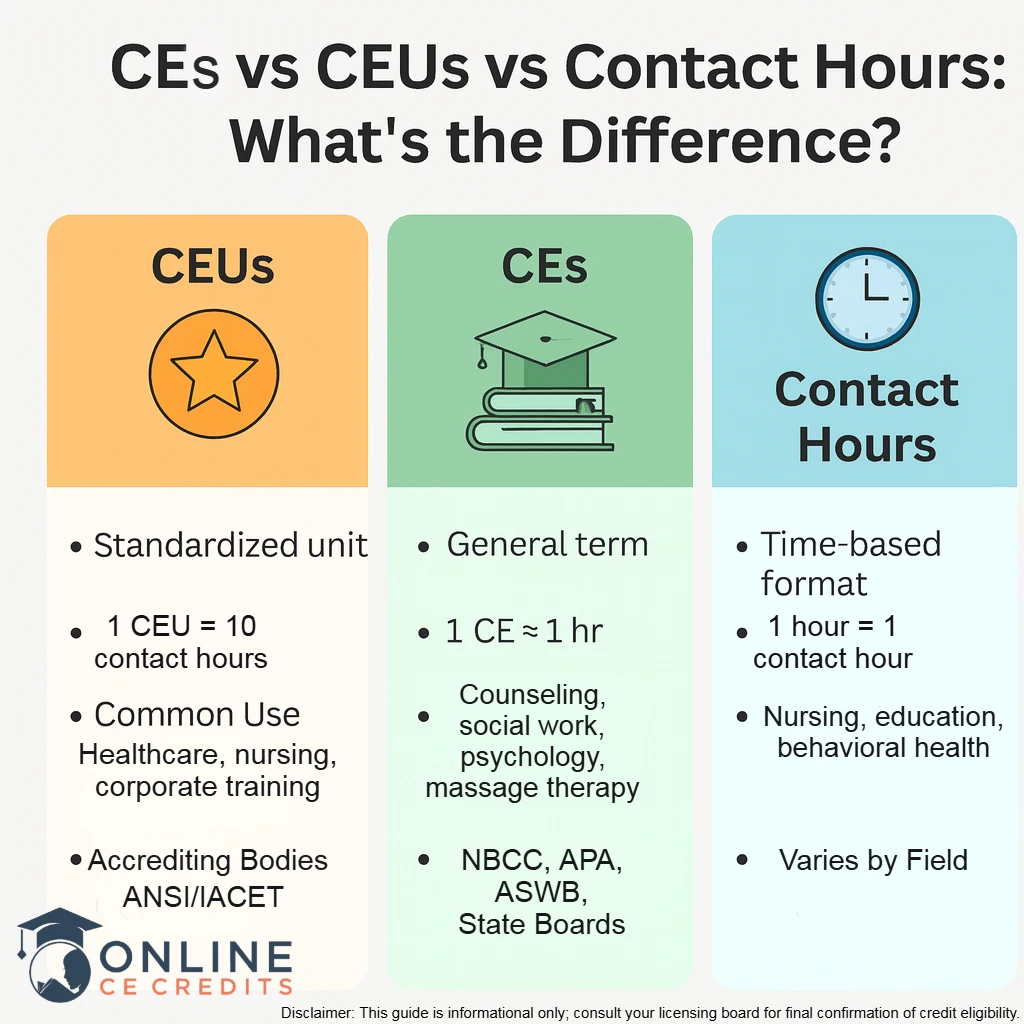
Sometimes. But not always.
The most important factor is how your board defines credit, not what the provider calls it.
How Licensing Boards Interpret Each Term
- Psychology Boards typically accept CEs from APA-approved providers.
- Nursing Boards often use CEUs or contact hours, but prefer ANCC-accredited activities.
- Counseling Boards vary by state; many align with NBCC or state-specific CEU terms.
A CE credit from one provider might not translate across professions or states. Always verify what format your license board accepts.
How to Know What/How Many CEs Your License Requires

Every state and profession defines requirements a little differently.
Some boards list requirements as:
- “30 CEUs every 2 years”
- “40 contact hours”
- “20 CE credits, including ethics and supervision”
While the language may vary, what matters is whether the provider is approved and the certificate includes the correct language.
You can search by profession and state using our license requirement lookup tool. Whether you’re in Florida, Texas, or California, this saves time and ensures compliance.
For Professionals – What to Look for Before Buying a CE / CEU Course
Before signing up for a course, check these essentials:
✅ Accreditation: Make sure the provider is approved by your board (e.g., NBCC, ASWB, APA, NAADAC)
✅ Credit Format: Does it clearly state CE credits, CEUs, or contact hours?
✅ Certificate Wording: Your board may reject certificates missing format or a provider number.
✅ Provider Number: Look for NBCC ACEP or state license approval listed.
You can view full CE approvals for all Online CE Credits courses.
Conclusion
While CEs, CEUs, and contact hours are often used interchangeably, their definitions and acceptance can differ depending on your profession and licensing board. Understanding these distinctions helps ensure that your continuing education efforts meet licensure requirements.
The most reliable approach is to choose accredited providers that clearly state how credit is awarded and which boards approve the course.
OnlineCECredits offers self-paced, board-approved courses that specify credit format and compatibility, making it easier to meet your continuing education goals with confidence.
FAQ
How many hours is 1 CEU worth?
One CEU equals 10 contact hours of participation in a structured continuing education program, typically led by a qualified instructor and accredited by an approved body.
How many credits is equal to 1 CEU?
Most licensing boards treat 1 CEU as 10 CE credits, since one CE credit usually represents one contact hour of approved educational activity.
Are online courses eligible for Continuing Education Units (CEUs)?
Yes, if the course is offered by an approved provider and clearly states the number of CEUs, CE credits, or contact hours awarded upon completion.
Are CEUs the same as credits?
Not exactly. CEUs measure 10 hours, while CE credits typically equal 1 hour each. Boards may accept either, depending on the language used in the regulations.
Why are Continuing Education Units important?
CEUs help professionals maintain competence, fulfill licensure requirements, and stay updated on ethical practices, clinical skills, and research-backed treatment strategies across specialties.
What are CEU credits good for?
CEU credits are used to renew licenses, expand clinical knowledge, and support career advancement in fields like counseling, psychology, social work, and healthcare.
Are CEUs worth it?
Yes. Earning CEUs shows a commitment to lifelong learning, helps meet state-mandated continuing education requirements, and strengthens professional development and public trust.